
At the bench, I treat an aerobic plate count as a measured estimate, not a verdict on whether a food is safe. It tells me how many colonies grew under the conditions of the chosen method. The sample, dilution, plating volume, incubation, and reporting rules all matter to that number.
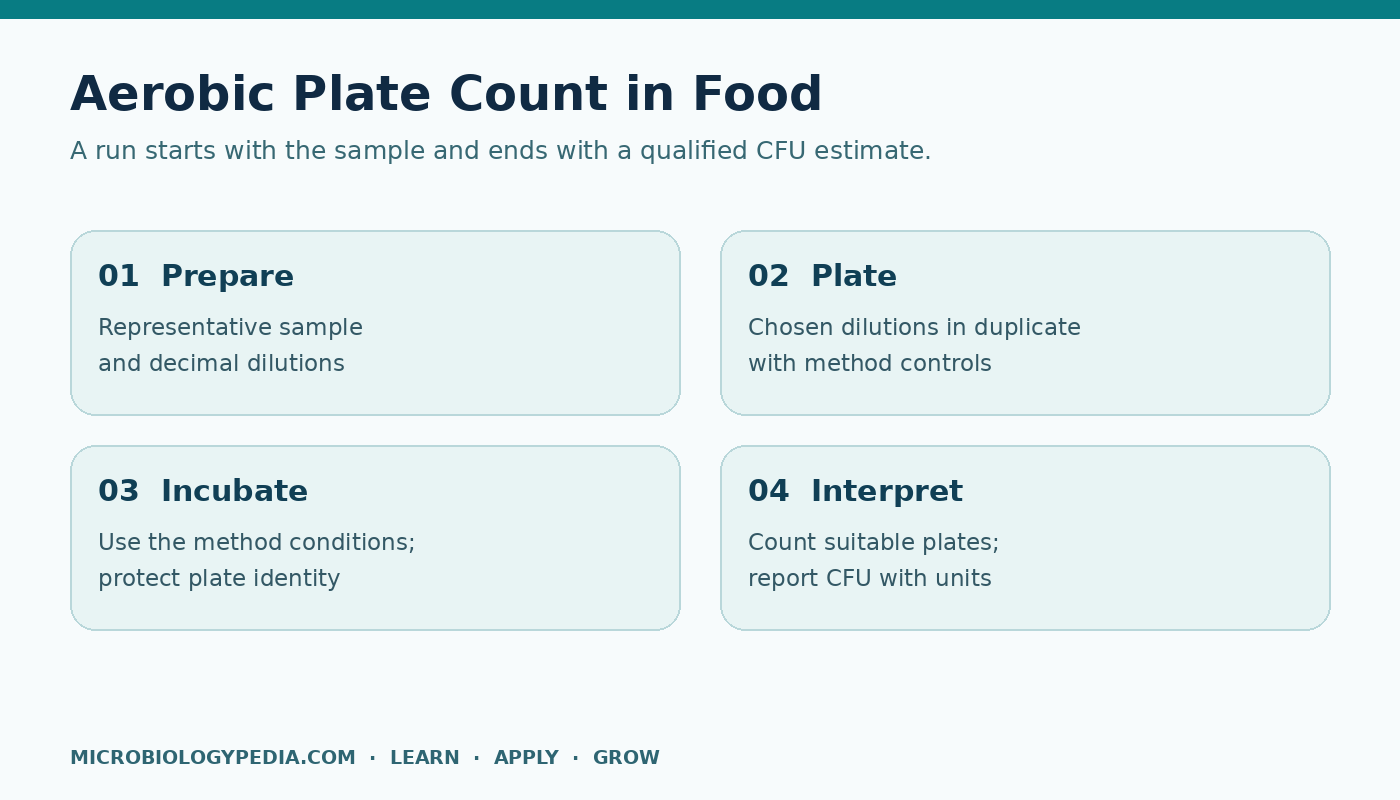
What I check before counting
I first confirm the sample ID, the preparation record, the dilution series, the plated volume, and the controls. A colony is counted as a colony-forming unit (CFU); one visible colony can arise from more than one cell. An aerobic plate count therefore estimates cultivable organisms recovered by that specific procedure. It does not identify a pathogen or prove its absence.
I also check whether the plated material was mixed and handled according to the method. If a dilution is mislabeled, the arithmetic can be flawless and the reported result still wrong. The FDA Bacteriological Analytical Manual (BAM) describes a conventional method with duplicate plates and defined preparation and incubation conditions. I use the approved method for the sample type rather than borrowing conditions from another matrix.
Choose plates by the method’s countable range
I record the actual colony counts before calculating. For the FDA BAM Chapter 3 conventional APC protocol, the current suitable range is 15–300 colonies per plate. Other methods may specify a different range, so I do not apply 15–300 to every food assay. Spreading growth, crowded plates, and plates outside range need the method’s prescribed reporting treatment; I do not quietly replace them with a convenient number.
A simple calculation to check the units
Suppose a single countable plate has 84 colonies from 1 mL of a 1:100 dilution of the original homogenate. That plate received 0.01 mL of the original homogenate, so 84 ÷ 0.01 = 8,400 CFU/mL of original homogenate. That is a teaching example, not a product result. Converting to CFU/g of food depends on the initial sample-to-diluent preparation. With duplicate plates or multiple dilutions, the current BAM calculation uses the original-homogenate volume represented across plates; I follow its calculation and rounding instructions instead of applying the single-plate shortcut to everything.
How I interpret the result
I compare like with like: same food type, sampling plan, test method, and reporting unit. A higher count may point me toward raw material quality, process hygiene, storage, or handling, but the count alone does not name the cause. I review trends and controls, then decide whether a separate pathogen test or investigation is required by the food safety plan.
My reporting check: Is the dilution traceable? Is the count within the method’s range? Have I kept the correct unit and significant figures? Have I distinguished the observed count from the interpretation? Those four questions catch many avoidable mistakes.
Reference
FDA, Bacteriological Analytical Manual, Chapter 3: Aerobic Plate Count (current edition). Follow your validated laboratory procedure and the version of the standard that governs your work.

Noman Iftikhar is a microbiologist with an MPhil in Microbiology and professional experience in pharmaceutical microbiology. His work includes sterility testing, bacterial endotoxin testing, microbial limit testing, environmental monitoring, and microbiological quality control. Through MicrobiologyPedia, he shares practical, evidence-based guidance to help microbiology students and laboratory professionals understand testing procedures, laboratory practices, and quality standards.