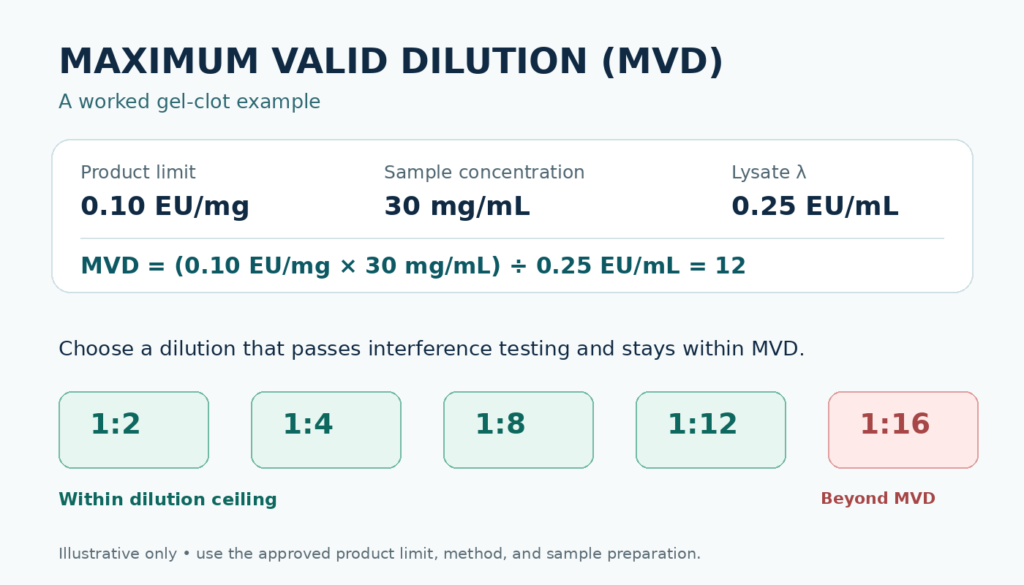
At the bench: λ (lambda) is the labeled sensitivity of a gel-clot lysate in EU/mL. Before I rely on a new lysate lot, I confirm that its measured endpoint is within the permitted range. This checks the reagent system; it is separate from testing whether a particular product inhibits or enhances the reaction.
Want to calculate it straight away? Use the free Lysate Sensitivity Confirmation Calculator: enter λ, tap +Ve or −Ve for each tube, and it shows each endpoint, its log, the geometric mean and whether λ is confirmed.
For context, read the gel-clot BET overview and the MVD calculation guide.
What concentrations do I prepare?
If the label states λ = 0.25 EU/mL, the four standard endotoxin concentrations are:
| Level | Concentration | Purpose |
|---|---|---|
| 2λ | 0.50 EU/mL | Higher challenge |
| λ | 0.25 EU/mL | Labeled sensitivity |
| 0.5λ | 0.125 EU/mL | Lower challenge |
| 0.25λ | 0.0625 EU/mL | Lowest challenge in the series |
I prepare the endotoxin standard with Water for BET and test four replicate dilution series, following the current compendial text and reagent instructions. I record the standard preparation, lot numbers, tube positions, incubation conditions, and each tube’s result before calculating anything.
How is a tube read?
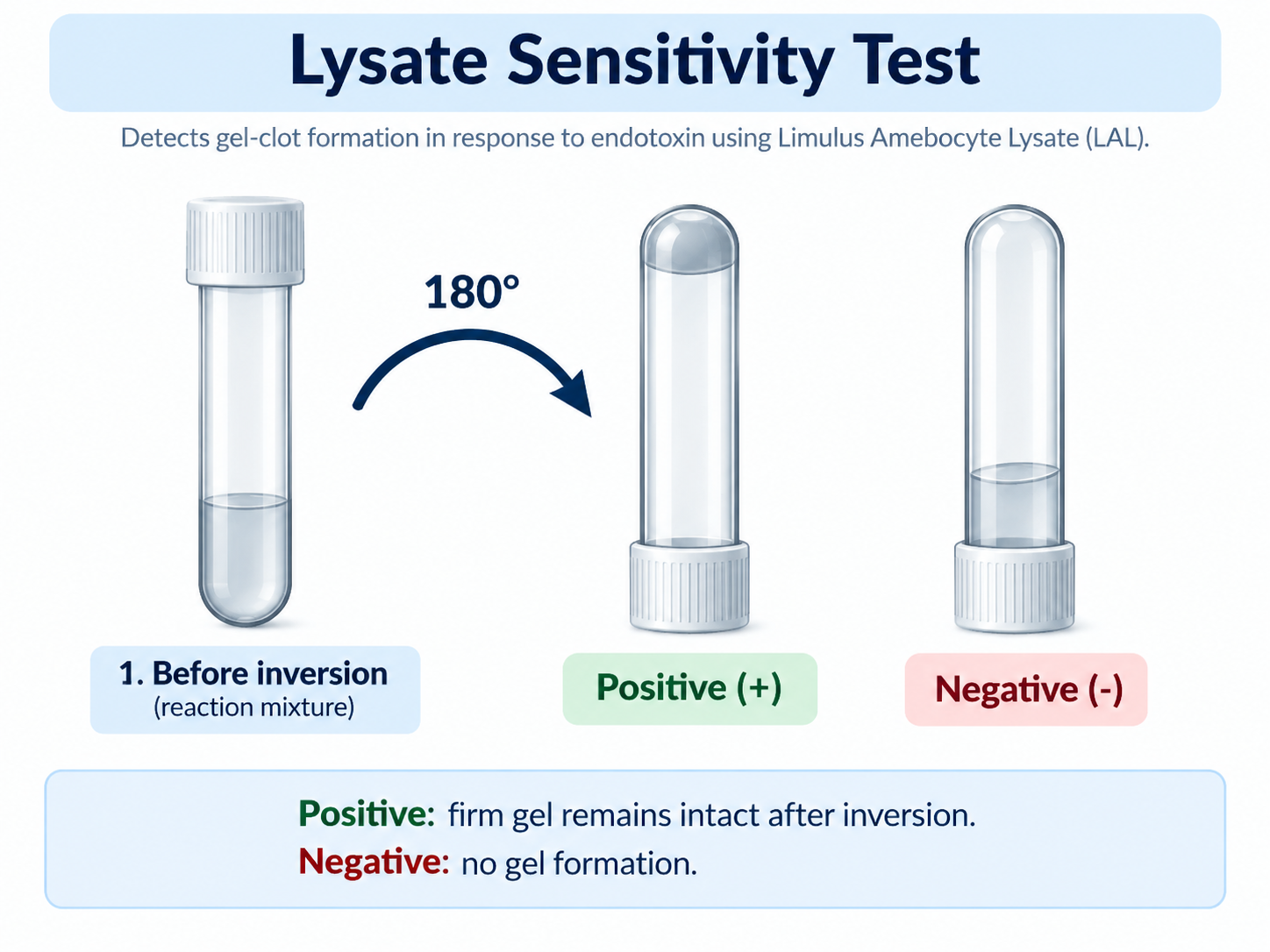
For a gel-clot reaction, I incubate without vibration under the specified conditions, then invert each tube smoothly through about 180°. A firm gel that remains intact is positive; liquid or a broken gel that moves is negative. The illustration below shows the physical readout, not the complete four-level dilution design.
Finding the endpoint
Within each replicate series, the endpoint is the lowest endotoxin concentration that still gives a positive clot. Suppose four illustrative endpoints are 0.25, 0.25, 0.125, and 0.25 EU/mL. Their geometric mean is:
(0.25 × 0.25 × 0.125 × 0.25)1/4 ≈ 0.210 EU/mL.
For λ = 0.25 EU/mL, the acceptance interval is 0.5λ to 2λ, or 0.125 to 0.50 EU/mL. The hypothetical mean is inside that interval. I would still confirm that the test was valid (the 0.25λ tubes negative in all four replicates) before documenting the lot as suitable.
Calculating the geometric mean with logarithms
USP <85> states the calculation as geometric mean endpoint concentration = antilog (Σe/f), where Σe is the sum of the log endpoint concentrations and f is the number of replicates. Using the same four endpoints:
| Replicate | Endpoint (EU/mL) | log10 (e) |
|---|---|---|
| 1 | 0.25 | −0.6021 |
| 2 | 0.25 | −0.6021 |
| 3 | 0.125 | −0.9031 |
| 4 | 0.25 | −0.6021 |
Σe = −2.7093, f = 4, Σe/f = −0.6773, and antilog (−0.6773) = 0.2102 EU/mL. This is the measured sensitivity of the lysate. The specification is NLT 0.5λ (0.125 EU/mL) and NMT 2λ (0.50 EU/mL), so λ = 0.25 EU/mL is confirmed. The calculator fills in this table for you.
When is the test valid?
The test is valid only when the lowest concentration, 0.25λ, gives a negative result in all replicates. A clot at 0.25λ means the lysate is reacting more strongly than expected, and the result cannot be used. If a replicate does not clot even at 2λ, that series has no endpoint and the labeled sensitivity cannot be confirmed; I investigate the reagent, the endotoxin standard and the procedure before repeating.
Where analysts get tripped up
- Arithmetic mean instead of geometric mean: the endpoints form a serial dilution series. I use the logarithmic/geometric calculation prescribed by the method.
- Confusing lysate confirmation with product suitability: a reagent can meet λ while a product sample still inhibits the test. The product interference study answers that second question.
- Calling one positive tube the endpoint: I read all levels in each series, identify its lowest positive concentration, and then calculate across the replicate endpoints.
- Ignoring unexpected controls: I investigate negative-control growth or gel formation and other failed validity checks before accepting the sensitivity calculation.
When would I repeat confirmation?
The harmonized USP text describes confirmation when a new lysate batch is used or test conditions change in a way that may affect the outcome. Site SOPs may impose additional controls. I check the current official chapter and the manufacturer’s instructions rather than treating an older worksheet as the authority.
Frequently Asked Questions (FAQs)
What concentrations are used to confirm lysate sensitivity?
At least four concentrations of the USP Endotoxin RS in Water for BET: 2λ, λ, 0.5λ and 0.25λ, each tested in four replicates.
When must labeled lysate sensitivity be confirmed?
USP <85> requires it when a new batch of lysate is used or when any change in test conditions may affect the outcome of the test.
What is the endpoint in the gel-clot test?
The smallest concentration in the series of decreasing standard endotoxin concentrations that clots the lysate.
How is the geometric mean endpoint concentration calculated?
Take the log10 of each replicate endpoint, add them (Σe), divide by the number of replicates (f), and take the antilogarithm: antilog (Σe/f).
What is the acceptance criterion?
The labeled sensitivity is confirmed when the geometric mean endpoint concentration is not less than 0.5λ and not more than 2λ.
When is the test not valid?
When the lowest concentration (0.25λ) gives a positive result in any replicate.
Related guides and tools: endotoxin limit calculation (K/M), the endotoxin limit calculator, the MVD calculator and sterility testing (USP <71>).
References
- USP <85>, Bacterial Endotoxins Test (current licensed text governs the procedure).
- USP public harmonization document for <85> (historical public text showing the four series and endpoint calculation).
This worked example is educational. Use the approved method, current chapter, and reagent instructions for actual qualification and release work.

Noman Iftikhar is a microbiologist with an MPhil in Microbiology and professional experience in pharmaceutical microbiology. His work includes sterility testing, bacterial endotoxin testing, microbial limit testing, environmental monitoring, and microbiological quality control. Through MicrobiologyPedia, he shares practical, evidence-based guidance to help microbiology students and laboratory professionals understand testing procedures, laboratory practices, and quality standards.