
At the bench: λ (lambda) is the labeled sensitivity of a gel-clot lysate in EU/mL. Before I rely on a new lysate lot, I confirm that its measured endpoint is within the permitted range. This checks the reagent system; it is separate from testing whether a particular product inhibits or enhances the reaction.
For context, read the gel-clot BET overview and the MVD calculation guide.
What concentrations do I prepare?
If the label states λ = 0.25 EU/mL, the four standard endotoxin concentrations are:
| Level | Concentration | Purpose |
|---|---|---|
| 2λ | 0.50 EU/mL | Higher challenge |
| λ | 0.25 EU/mL | Labeled sensitivity |
| 0.5λ | 0.125 EU/mL | Lower challenge |
| 0.25λ | 0.0625 EU/mL | Lowest challenge in the series |
I prepare the endotoxin standard with Water for BET and test four replicate dilution series, alongside the required negative controls, following the current compendial text and reagent instructions. I record the standard preparation, lot numbers, tube positions, incubation conditions, and each tube’s result before calculating anything.
How is a tube read?
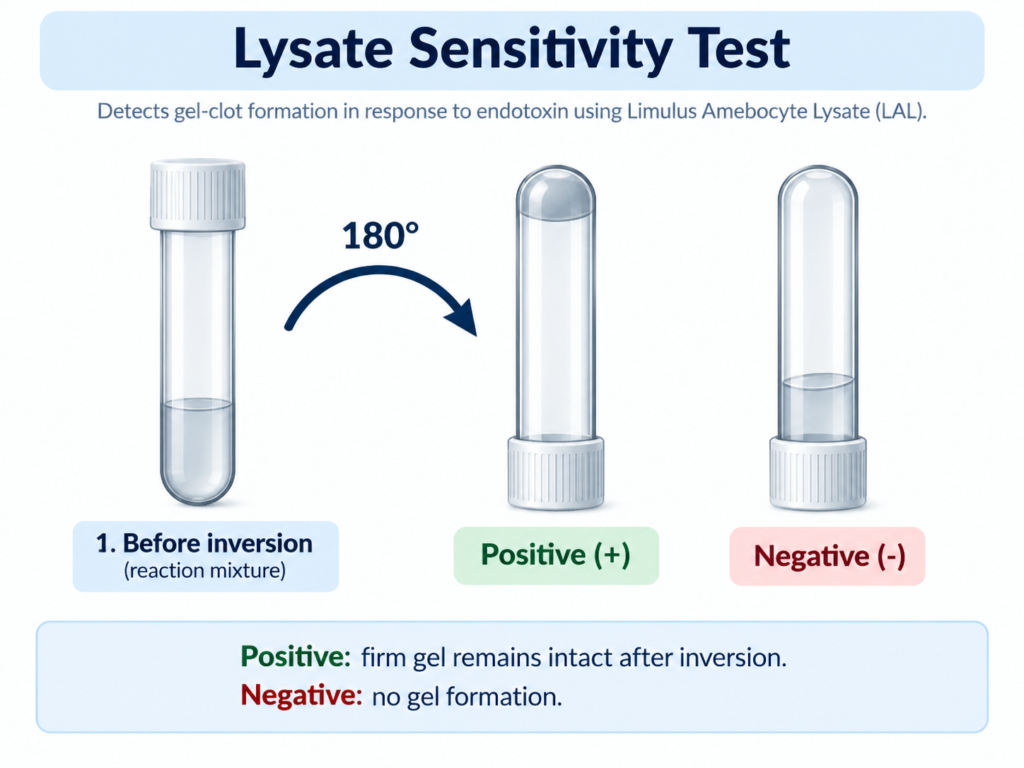
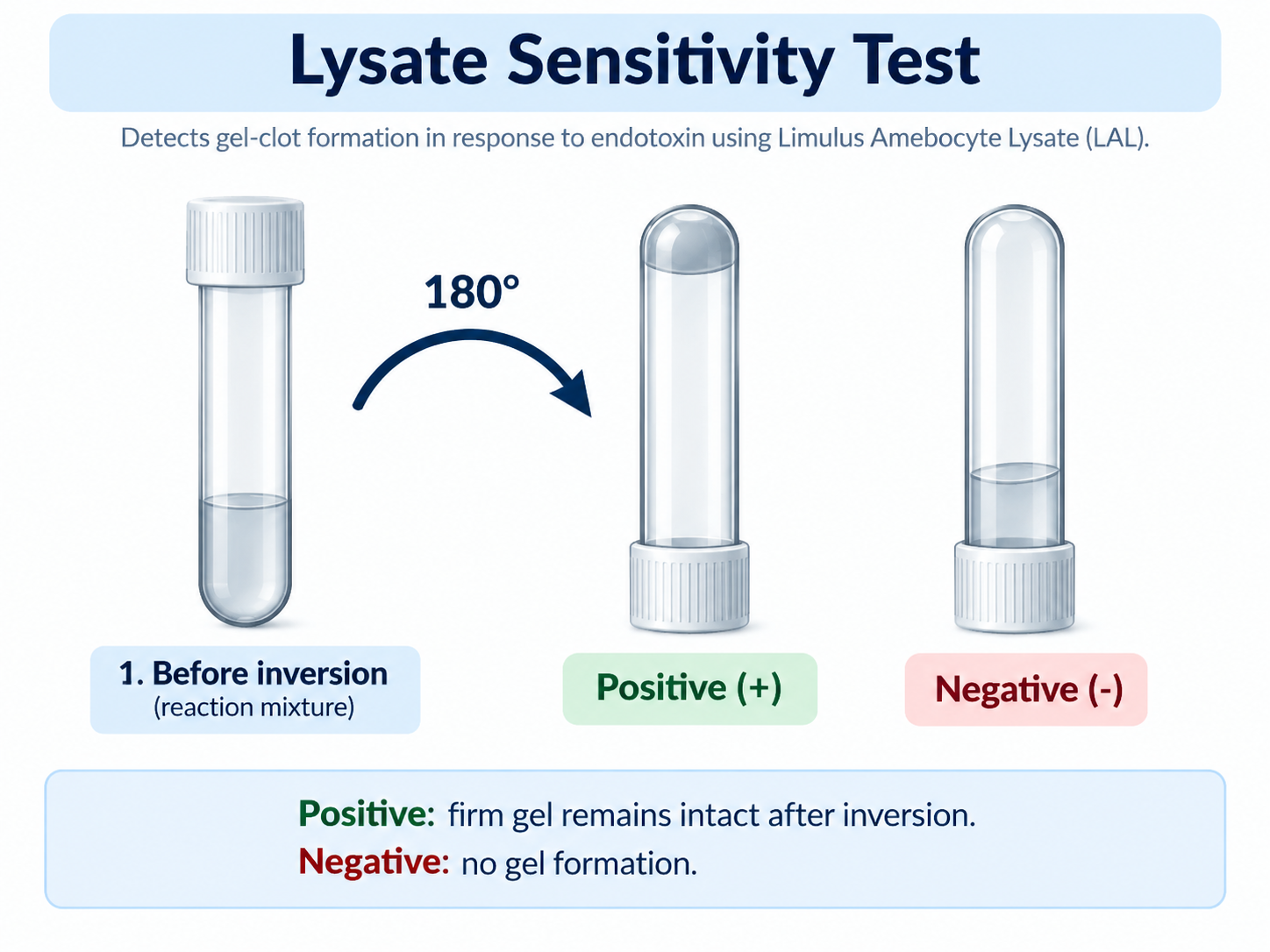
For a gel-clot reaction, I incubate without vibration under the specified conditions, then invert each tube smoothly through about 180°. A firm gel that remains intact is positive; liquid or a broken gel that moves is negative. The illustration below shows the physical readout, not the complete four-level dilution design.
Finding the endpoint
Within each replicate series, the endpoint is the lowest endotoxin concentration that still gives a positive clot. Suppose four illustrative endpoints are 0.25, 0.25, 0.125, and 0.25 EU/mL. Their geometric mean is:
(0.25 × 0.25 × 0.125 × 0.25)1/4 ≈ 0.210 EU/mL.
For λ = 0.25 EU/mL, the acceptance interval is 0.5λ to 2λ, or 0.125 to 0.50 EU/mL. The hypothetical mean is inside that interval. I would still confirm that the required negative controls and other validity conditions passed before documenting the lot as suitable.
Where analysts get tripped up
- Arithmetic mean instead of geometric mean: the endpoints form a serial dilution series. I use the logarithmic/geometric calculation prescribed by the method.
- Confusing lysate confirmation with product suitability: a reagent can meet λ while a product sample still inhibits the test. The product interference study answers that second question.
- Calling one positive tube the endpoint: I read all levels in each series, identify its lowest positive concentration, and then calculate across the replicate endpoints.
- Ignoring unexpected controls: I investigate negative-control growth or gel formation and other failed validity checks before accepting the sensitivity calculation.
When would I repeat confirmation?
The harmonized USP text describes confirmation when a new lysate batch is used or test conditions change in a way that may affect the outcome. Site SOPs may impose additional controls. I check the current official chapter and the manufacturer’s instructions rather than treating an older worksheet as the authority.
References
- USP <85>, Bacterial Endotoxins Test (current licensed text governs the procedure).
- USP public harmonization document for <85> (historical public text showing the four series and endpoint calculation).
This worked example is educational. Use the approved method, current chapter, and reagent instructions for actual qualification and release work.