
In brief: Bacterial endotoxin is lipopolysaccharide (LPS) from the outer membrane of Gram-negative bacteria. A bacterial endotoxins test (BET) checks whether a sample exceeds its specified endotoxin limit. In the gel-clot method, a firm clot that remains intact when the tube is inverted is positive.
What is bacterial endotoxin?
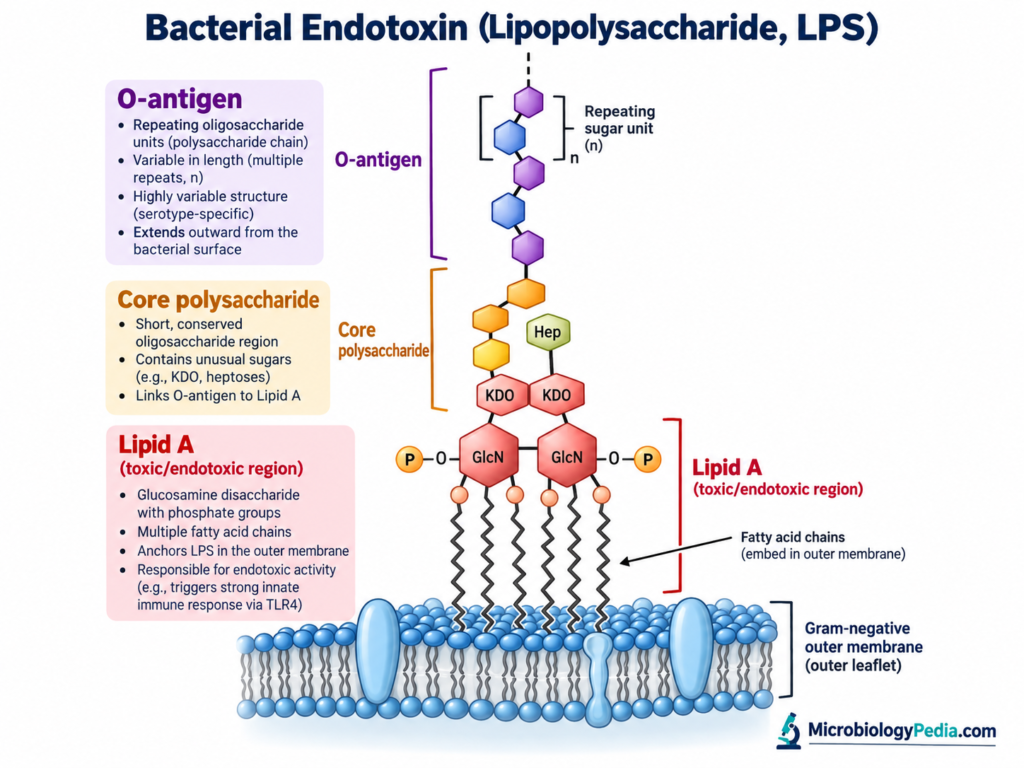
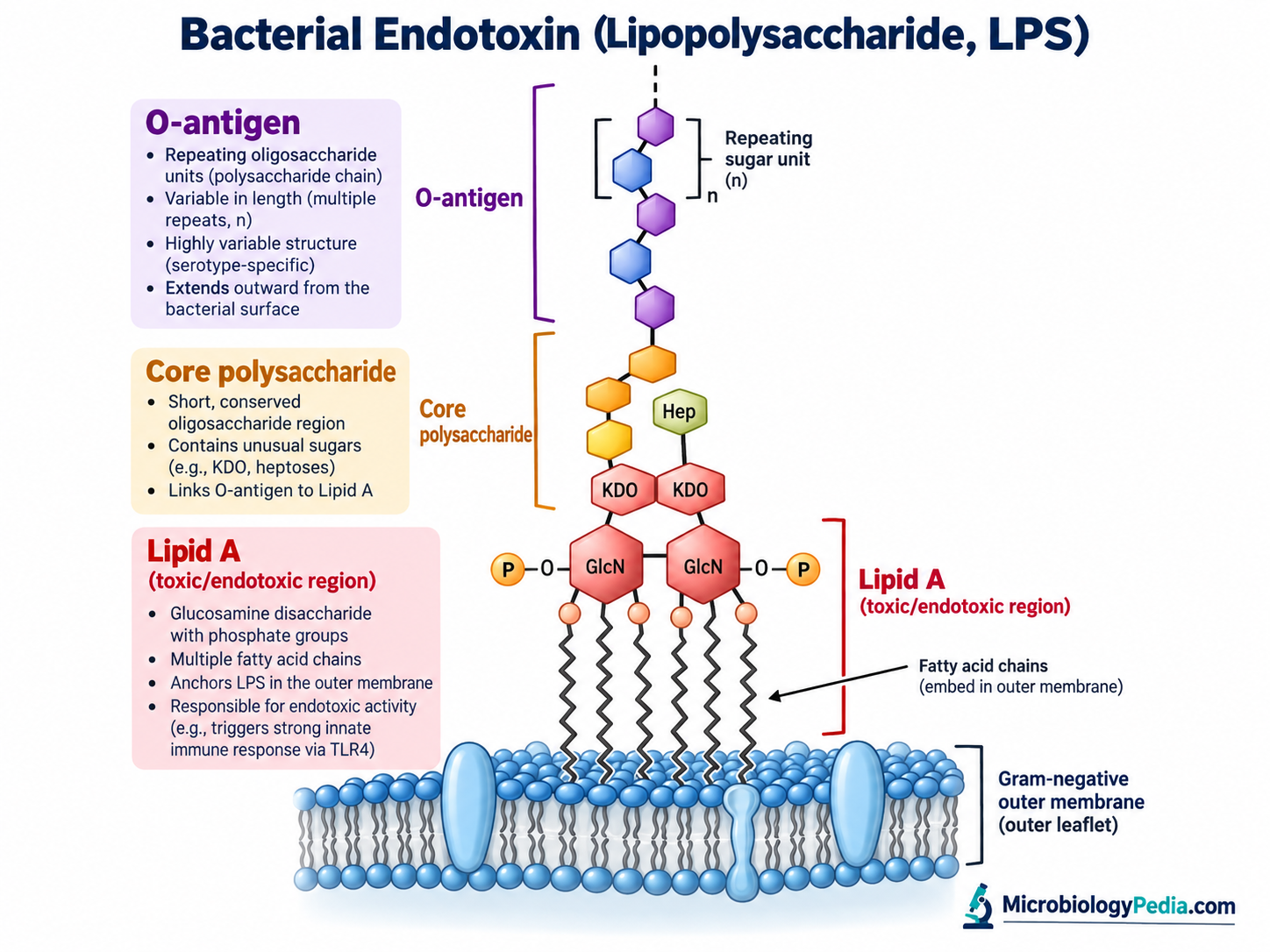
Endotoxin is the LPS associated with the outer membrane of Gram-negative bacteria. Its three main regions are Lipid A, the core polysaccharide, and the O-antigen. Lipid A is the membrane anchor and the principal driver of the inflammatory response. Endotoxin can remain a concern even after bacteria are killed; sterility and endotoxin control answer different questions.
In pharmaceutical QC, I first distinguish the product limit from the assay sensitivity. The limit states how much endotoxin the product may contain; the sensitivity (λ) states the lowest concentration the chosen gel-clot lysate is labeled to detect under the test conditions. A negative tube cannot be interpreted without a valid method, appropriate dilution, and working controls.
Which methods are used?
| Method | Readout | Typical use |
|---|---|---|
| Gel-clot | Presence or absence of an intact clot | Qualitative limit testing or endpoint determination |
| Turbidimetric | Change in cloudiness | Quantitative measurement |
| Chromogenic | Color development | Quantitative measurement |
This guide focuses on the gel-clot technique used in many QC laboratories. USP also recognizes other BET methods, and USP <86> describes recombinant reagent techniques. The selected method must be suitable for the particular product.
Before I start a gel-clot run
- Check the limit and sample concentration. I use the product’s approved specification and preparation instructions; a generic endotoxin limit is not safe to assume for every drug.
- Calculate the maximum valid dilution (MVD). For a concentration-based limit, MVD = (endotoxin limit × sample concentration) ÷ λ. This is the dilution ceiling, not the dilution I must always use.
- Confirm the reagents and containers. I use endotoxin-controlled water, calibrated pipettes, and containers shown suitable for BET. A claimed time/temperature treatment is not a substitute for a validated depyrogenation process.
- Check the lysate and product interference. Labeled lysate sensitivity must be confirmed as required, and the product must be shown not to inhibit or enhance the reaction at the chosen dilution.
For example, a product concentration of 30 mg/mL, a limit of 0.10 EU/mg, and λ = 0.25 EU/mL gives MVD = (30 × 0.10) / 0.25 = 12. This is an illustrative calculation. The actual release dilution must also pass product-specific interference testing.
How I read a gel-clot test
After preparing the sample, positive product control, positive control, and negative control according to the approved method, the tubes are incubated undisturbed under the compendial and reagent instructions. A common gel-clot condition is 37 ± 1°C for 60 ± 2 minutes. I then invert each tube once, gently, through 180°.
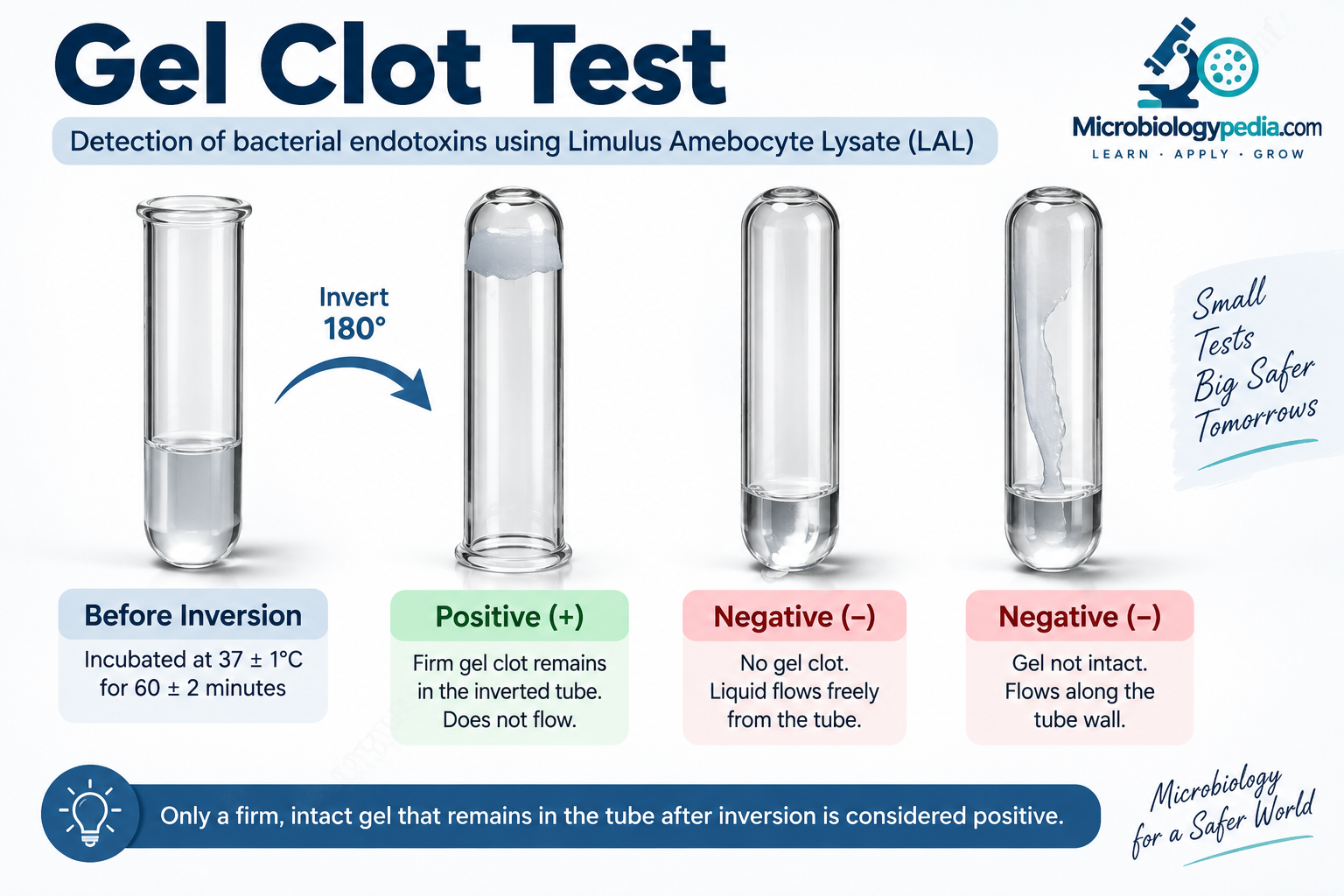
- Positive: a firm, intact gel remains in the inverted tube.
- Negative: liquid flows, or the gel is not intact and slips down the tube wall.
- Invalid run: a required control behaves unexpectedly. I investigate the run rather than reporting a product pass or fail from invalid controls.
A negative result at a suitable dilution means endotoxin was not detected at that test’s effective threshold. It does not mean the sample contains zero endotoxin. A positive result must be interpreted with the test dilution, product limit, controls, and the approved repeat/OOS procedure.
Three bench errors I check first
- Wrong dilution or units: EU/mg, EU/mL, and EU/vial are not interchangeable. I write the units through every MVD calculation.
- Product inhibition: a negative sample with a failed positive product control can hide endotoxin. I resolve the interference within the MVD before treating a negative as meaningful.
- Disturbed incubation: moving or vibrating tubes can damage a forming clot. I keep the incubation conditions consistent and read tubes with one deliberate inversion.
Continue the BET workflow
- Calculate maximum valid dilution (MVD) with a worked example.
- Confirm labeled lysate sensitivity with four replicate series.
References
- USP <85>, Bacterial Endotoxins Test (consult the current licensed chapter for the controlling procedure).
- FDA, Pyrogen and Endotoxins Testing: Questions and Answers, Edition 2 (March 2026).
- USP <86>, Bacterial Endotoxins Test Using Recombinant Reagents.
Educational guide. Follow your current compendial chapter, approved product specification, validated method, and site SOP for testing and release decisions.
Pingback: Maximum Valid Dilution (MVD) in BET: Formula and Worked Example - microbiologypedia
Pingback: Lysate Sensitivity Confirmation for Gel-Clot BET: A Practical Guide - microbiologypedia