
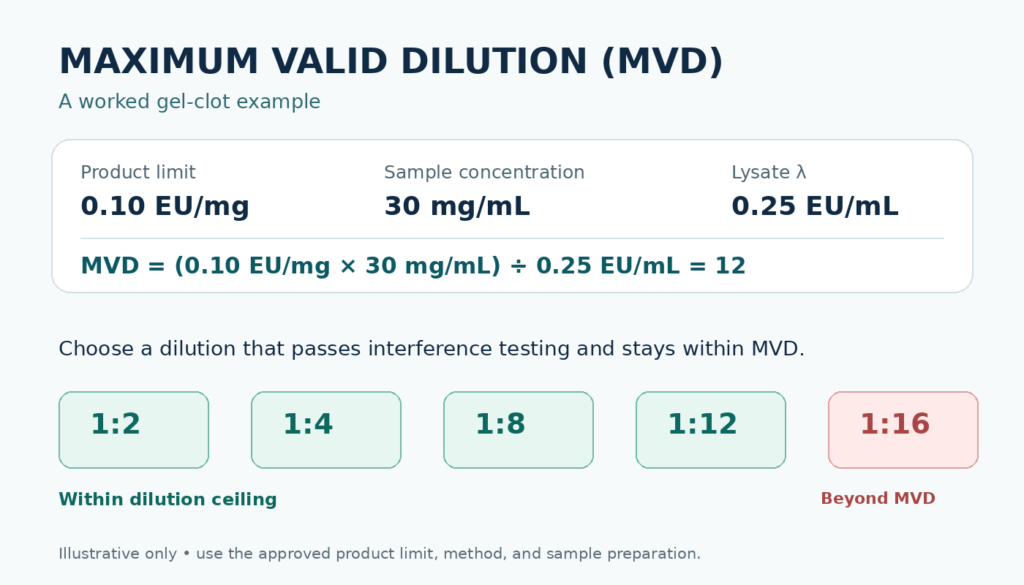
Quick answer: Maximum valid dilution (MVD) is the greatest dilution at which the selected endotoxin test can still detect the product’s endotoxin limit. It sets an upper boundary. I choose my routine test dilution only after confirming that the product does not interfere at that dilution.
If you are new to the test, start with what bacterial endotoxin is and how the gel-clot test works.
The MVD formula
When the endotoxin limit is expressed per unit of product mass, I use:
MVD = (endotoxin limit in EU/mg × sample concentration in mg/mL) ÷ lysate sensitivity λ in EU/mL
The mg and EU units cancel, leaving a dimensionless dilution factor. If the specification is in EU/mL and the starting sample is already the final product solution, the concentration term is handled differently: MVD = limit in EU/mL ÷ λ in EU/mL. I always identify the form of the product limit before selecting a formula.
Worked example: where does 1:12 come from?
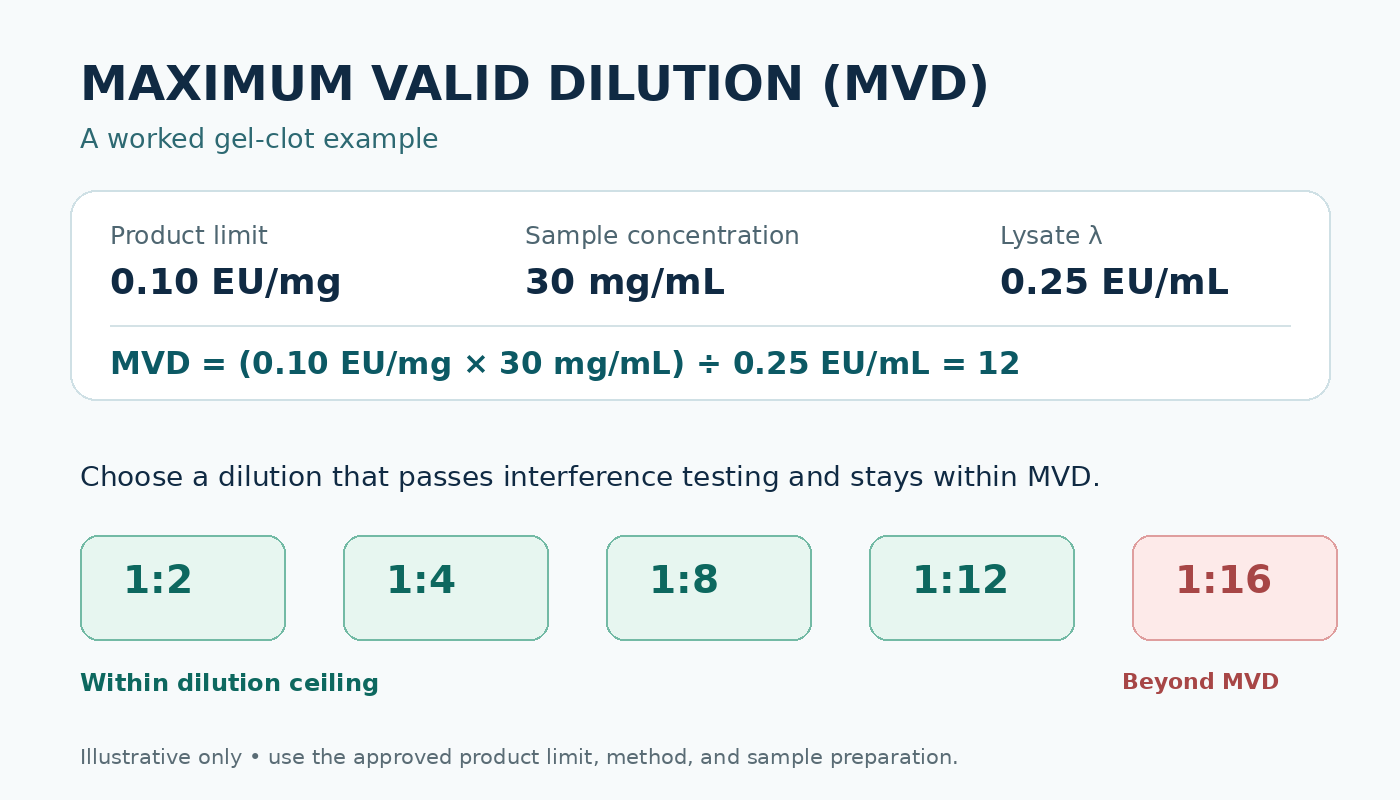
Suppose the approved endotoxin limit is 0.10 EU/mg, the prepared sample contains 30 mg/mL, and the gel-clot lysate sensitivity is 0.25 EU/mL.
- Convert the product limit into a concentration in the undiluted sample: 0.10 EU/mg × 30 mg/mL = 3.0 EU/mL.
- Divide by the sensitivity: 3.0 EU/mL ÷ 0.25 EU/mL = 12.
- The theoretical ceiling is therefore 1:12. A 1:16 dilution would be too dilute to assess that limit with this sensitivity.
At the bench, I would evaluate practical dilutions such as 1:2, 1:4, or 1:8 for interference and use a validated dilution that stays at or below 1:12. I would not simply choose 1:12 because it is the largest number. A smaller dilution gives more analytical margin if the sample matrix permits it.
Why the chosen dilution matters
Highly concentrated or otherwise interfering products can inhibit or enhance gel formation. Dilution can sometimes remove that interference, but it also dilutes the endotoxin. The usable range lies where the positive product control works and the dilution does not exceed the MVD.
| Question | What I check |
|---|---|
| Is the dilution allowed? | It is no greater than the calculated MVD. |
| Is the result valid? | Required positive and negative controls behave as specified. |
| Does product interfere? | The positive product control or the formal interference study meets the approved criteria. |
| Are units consistent? | The approved limit and prepared concentration are recorded in compatible units. |
Common calculation mistakes
- Using label strength without considering preparation. If a vial is reconstituted or diluted before testing, I calculate from the concentration of the actual sample solution.
- Mixing EU/vial and EU/mg. I do not multiply an EU/mL limit by mg/mL. First I align the specification and sample units.
- Treating MVD as a pass result. It only tells me how far dilution may go. It says nothing about the observed gel-clot result or product interference.
- Ignoring pooling. If finished units are pooled, FDA’s March 2026 guidance describes an adjusted MVD for certain pooled small-volume parenterals. Pooling needs a justified, approved sampling procedure.
What I record on a worksheet
I retain the product and specification reference, endotoxin limit with units, sample preparation and concentration, lysate lot and λ, arithmetic, chosen test dilution, interference evidence, and control results. This makes the calculation reproducible during review and prevents a plausible-looking number from hiding a unit error.
References
- USP <85>, Bacterial Endotoxins Test.
- FDA, Pyrogen and Endotoxins Testing: Questions and Answers, Edition 2 (March 2026), especially its discussion of testing and pooled samples.
The numerical example is illustrative; use the current product specification and approved method for release testing.
Pingback: What Is Bacterial Endotoxin? How to Test It - microbiologypedia