Sterility testing is an essential microbiological quality control test performed on products that are required to be sterile. It helps detect viable microbial contamination in the prescribed sample and supports the assessment of finished-product quality before batch release.
In pharmaceutical microbiology laboratories, the reliability of sterility testing depends on proper sample selection, suitable culture media, validated test methods, aseptic handling, qualified facilities, and accurate interpretation of results.
This article explains sterility testing from a practical laboratory perspective, including the materials and equipment required, preparation of the testing area, membrane filtration, direct inoculation, sample quantities, incubation, and investigation of positive results.
1. Definition of Sterility Testing
Sterility testing is a microbiological examination performed to determine whether viable microorganisms can be detected in a prescribed sample of a pharmaceutical product that is required to be sterile, using the specified culture media and test conditions.
The principal United States Pharmacopeia reference is USP General Chapter <71>, Sterility Tests. The applicable pharmacopoeia, product monograph, approved specification, and current laboratory SOP must be consulted before testing.
Important: A passing sterility test does not prove that every unit in a batch is sterile. Sterility assurance primarily depends on a validated sterilization process or a properly controlled aseptic manufacturing process, supported by an effective contamination control strategy.
2. Purpose of Sterility Testing
The main purposes are to:
- Detect viable microbial contamination in the prescribed product sample.
- Assess compliance with the applicable pharmacopoeial sterility requirements.
- Support finished-product quality assessment and batch disposition.
- Identify potential contamination concerns requiring investigation.
- Provide supporting evidence for the effectiveness of the overall contamination control system.
Sterility testing must be interpreted alongside manufacturing records, environmental monitoring, sterilization or aseptic processing records, and other relevant quality information.
3. Materials and Equipment Required
The required materials depend on the product, the selected test method, and the approved SOP.
3.1 Equipment and Instructions
- Qualified laminar airflow (LAF) or BSC workstation or suitable qualified aseptic processing system.
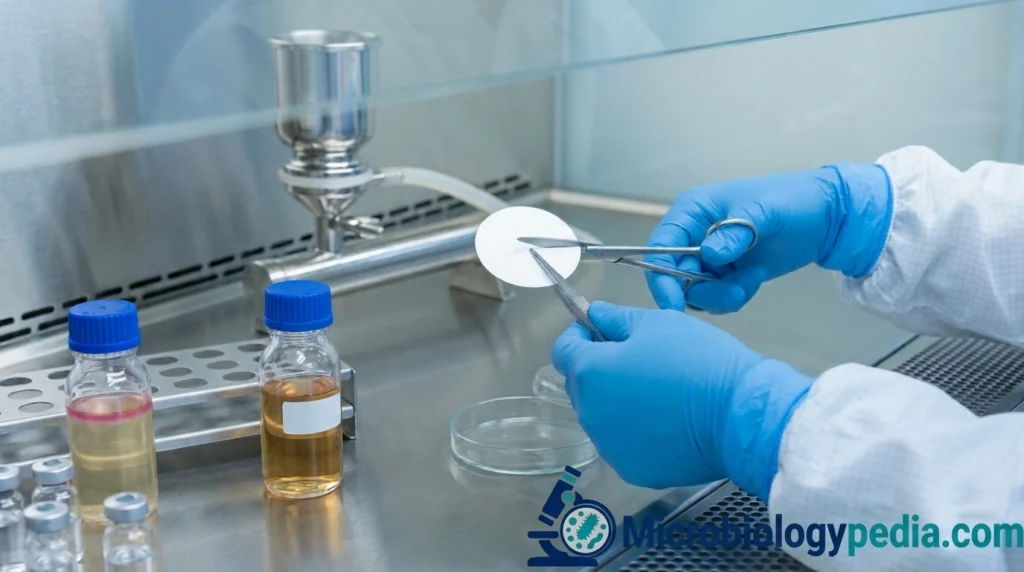
- Membrane filtration assembly
- Vacuum source.
- Sterilized forceps.
- Sterilized scissors.
- Incubators
- Autoclave
- Dry-heat sterilizer
- Sterile gloves and other required personal protective equipment.
- Sterile cellulose nitrate membrane filters, typically with a nominal pore size of not more than 0.45 µm.
- Fluid Thioglycollate Medium (FTM). Ensure culture media have passed the required Growth Promotion Test (GPT).
- Soybean–Casein Digest Medium (SCDM), commonly called Tryptic Soy Broth (TSB). Ensure culture media have passed the required Growth Promotion Test (GPT).
All materials must be within their applicable expiry and should be sterilized before use.
4. Sample Quantity and Number of Units According to USP <71>
Two separate considerations determine the amount of product tested:
- The quantity taken from each container for each culture medium.
- The minimum number of containers or articles selected from the batch.
These requirements are addressed separately in the USP <71> framework. The applicable product monograph and current official chapter take precedence over a general summary.
4.1 Minimum quantity of product for each medium
The following table summarizes the general quantities for common product types.
| Product type | Minimum quantity for each medium |
|---|---|
| Liquid products containing less than 1 mL | Entire contents of each container |
| Liquid products containing 1–40 mL | Half the contents, but not less than 1 mL |
| Liquid products containing more than 40 mL and up to 100 mL | 20 mL |
| Liquid products containing more than 100 mL | 10% of the contents, but not less than 20 mL |
| Antibiotic liquids | 1 mL |
| Solids containing less than 50 mg | Entire contents |
| Solids containing 50 mg or more but less than 300 mg | Half the contents, but not less than 50 mg |
| Solids containing 300 mg–5 g | 150 mg |
| Solids containing more than 5 g | 500 mg |
| Insoluble preparations, creams, and ointments | Quantity providing at least 200 mg, prepared as appropriate for testing |
These are general compendial quantities, not a universal sample-volume instruction for every product. Special product categories, dosage forms, and individual monographs may require different provisions.
4.2 Minimum number of articles selected from the batch
For common product categories, the general USP <71> sampling framework includes the following:
| Product category and batch size | Minimum number of articles to test |
|---|---|
| Parenteral preparations: not more than 100 containers | 10% or 4 containers, whichever is greater |
| Parenteral preparations: more than 100 and not more than 500 containers | 10 containers |
| Parenteral preparations: more than 500 containers | 2% or 20 containers, whichever is less |
| Large-volume parenterals | 2% or 10 containers, whichever is less |
| Ophthalmic and other non-injectable preparations: not more than 200 containers | 5% or 2 containers, whichever is greater |
| Ophthalmic and other non-injectable preparations: more than 200 containers | 10 containers |
Other product categories, including antibiotic solids, bulk solid products, and medical devices, have separate provisions.
5. Preparation of the Sterility Testing Area
The sterility testing area must be prepared before introducing samples or beginning the test. The objective is to minimize contamination from personnel, surfaces, equipment, and unnecessary interventions.
5.1 Cleaning and disinfection
- Perform the prescribed cleaning of work surfaces, equipment exteriors, and relevant room surfaces.
- Mop the cleanroom floor using the approved cleaning and disinfection procedure.
- Clean and disinfect the LAF workstation or suitable qualified aseptic processing system.
- Clean and disinfect instruments and accessories as required before transfer into the critical area.
- Observe the approved disinfectant concentration, contact time, application method, and rotation requirements, where applicable.
- Allow surfaces to dry where required by the disinfectant instructions and SOP.
The cleaning and disinfection sequence, including floor mopping and workstation preparation, must follow the approved room-specific procedure.
5.2 Personnel entry and gowning
Personnel must be trained and qualified for the applicable cleanroom grade and sterility testing operation.
The entry process generally includes:
- Remove prohibited personal items and follow the facility’s entry requirements.
- Perform the prescribed hand hygiene and gowning sequence.
- Wear the required cleanroom garment, hood, mask, footwear, and sterile gloves, as applicable to the operation.
- Complete the required gowning checks before entering the classified area.
- Follow the approved transfer and entry procedure for the sterility testing room.
- Disinfect gloves when required and replace them if contaminated, damaged, or otherwise unsuitable.
The exact gowning sequence and garment requirements depend on the classified area, facility design, and approved SOP.
5.3 Entry of samples and materials
The external surfaces of sample containers and transferred materials must be disinfected using an approved method compatible with the packaging.
Where required, allow the disinfectant to remain in contact for the specified period and ensure that the exterior is suitably dry before aseptic manipulation.
Do not allow disinfectant to enter the sample or contact the product in a way that could inhibit microbial recovery.
5.4 Aseptic handling and particle control
During sterility testing:
- Handle all materials carefully to minimize particle generation.
- Avoid unnecessary movements, talking, rapid hand movements, and excessive interventions.
- Do not obstruct the airflow pattern of the qualified workstation.
- Keep materials arranged to prevent contamination and avoid unnecessary reaching across exposed sterile items.
- Minimize the duration for which sterile components are exposed.
- Maintain appropriate separation between clean materials, samples, and waste.
The purpose is not merely to keep the work area visually clean; it is to protect the test from extraneous contamination and preserve the validity of the results.
6. Testing Environment: LAF, BSC, and Cleanroom Grade
A suitable qualified unidirectional-airflow workstation or other approved aseptic processing system is used according to the facility design and applicable requirements.
The background cleanroom grade must be established through the applicable regulatory requirements, risk assessment, and approved facility design.
A generic biological safety cabinet (BSC) must not automatically be assumed suitable for sterility testing. Its airflow design, protection characteristics, qualification, and intended use must be assessed before use.
Where the approved facility design requires Grade A conditions with a Grade B background, the relevant conditions must be qualified and maintained.
Routine environmental monitoring, equipment qualification, cleaning, maintenance, and personnel qualification support the integrity of the testing environment.
7. Culture Media Used in Sterility Testing
Two principal media are used in the conventional USP <71> sterility test.
7.1 Fluid Thioglycollate Medium (FTM)
FTM supports the recovery of anaerobic bacteria and can also support certain aerobic bacteria.
- General incubation range: 30–35 °C.
- Conventional USP <71> incubation period: not less than 14 days.
7.2 Soybean–Casein Digest Medium (SCDM/TSB)
SCDM, commonly called Tryptic Soy Broth, supports a broad range of aerobic bacteria and fungi.
- General incubation range: 20–25 °C.
- Conventional USP <71> incubation period: not less than 14 days.
The media must meet the applicable quality requirements, including growth promotion testing, and must be suitable for the selected test method.
8. Membrane Filtration Method
Membrane filtration is generally preferred when the product can be filtered without compromising microbial recovery.
8.1 Preparation of Filtration Assembly
- Verify that the filtration assembly and components have been sterilized.
- Aseptically place the sterile membrane filter on the filter support and secure the filtration assembly.
- Use a product-compatible membrane with a nominal pore size not greater than 0.45 µm.
- Connect the assembly to the vacuum pump.
8.2 Sample Preparation
- Verify the sample name, batch number, and other relevant details.
- Disinfect the external surface of the sample container.
- If sample is in powder form dissolve it in a suitable sterile diluent.
8.3 Sample Filtration and Rinsing
- Aseptically open the sample container and transfer the prescribed sample quantity into the filtration assembly.
- Filter the sample through the membrane using the approved procedure.
- Rinse the membrane with the specified sterile rinsing fluid, where required, using the validated rinsing procedure to remove inhibitory residues.
8.4 Membrane Transfer to Culture Media
- Aseptically remove the membrane using sterile forceps. Divide the membrane using sterile scissors.
- Transfer the one half into FTM and other half in the TSB. Ensure appropriate membrane immersion, close the vessels.
- Label the sample with product name, batch number and Test date any other important information.
8.5 Incubation
- Incubate FTM at 30–35 °C and TSB at 20–25 °C.
- Maintain incubation for not less than 14 days.
8.6 Observation and Recording
- Examine the media daily and record the observation on the reporting sheet.
- Record any evidence of microbial growth, including turbidity, surface growth, or sediment.
9. Direct Inoculation Method
Direct inoculation is an alternative method in which the prescribed quantity of product is transferred directly into the appropriate culture medium rather than passing through a membrane filter.It may be suitable for products that cannot appropriately be tested by membrane filtration.
9.1 Procedure
- Verify the sample identity and the required quantity for each medium.
- Prepare the specified culture media and required controls.
- Disinfect the exterior of the sample container using the approved procedure.
- Open the container aseptically.
- Transfer the prescribed product quantity directly into the FTM and TSB.
- Incubate FTM at 30–35 °C and TSB at 20–25 °C for 14 days.
- Observe the media daily and document the results.
10. Result Interpretation
At prescribed intervals during incubation and at its conclusion, examine the culture media for macroscopic evidence of microbial growth.
10.1 No evidence of microbial growth
If no evidence of microbial growth is observed at the end of the prescribed incubation period, and the test is valid, the product complies with the sterility test under the applicable pharmacopoeial requirements.
This conclusion applies to the sample under test; it does not prove that every unit in the batch is sterile.
10.2 Evidence of microbial growth
If microbial growth is detected, the product does not comply with the sterility test unless the test is demonstrated to be invalid for a cause unrelated to the product, according to the applicable pharmacopoeial requirements.
The laboratory must document the result and initiate the required investigation.
10.3 When the product makes the medium difficult to interpret
If the product causes turbidity or another visual effect that prevents reliable determination of whether microbial growth is present.
At 14-day incubation period, portions of the medium, each not less than 1 mL, are transferred to fresh vessels containing the same medium. The original and transfer vessels are then incubated for not less than an additional 4 days.
10.4 Conditions for declaring a test invalid
A sterility test may be declared invalid only when the applicable compendial criteria are met and objective evidence supports the decision.
Examples include:
- Microbiological monitoring data demonstrate a fault in the sterility testing facility.
- Review of the testing procedure identifies a documented fault in execution.
- Microbial growth is detected in the negative controls.
- Identification of the recovered microorganism provides unequivocal evidence that the growth resulted from a fault associated with the materials or technique used during the test.
10.5 Repeat testing
When a test is declared invalid, repeat the test using the same number of units as in the original test, in accordance with the applicable pharmacopoeial requirements.
- If no microbial growth is detected in the repeat test, the product complies with the sterility test, provided all applicable requirements are met.
- If microbial growth is detected in the repeat test, the product does not comply with the sterility test.
A repeat test must not be used simply to obtain a passing result.
11. Essential Controls in Sterility Testing
Appropriate controls help establish that the test conditions and materials are suitable.
Negative controls
Negative controls are used to detect contamination introduced by the testing materials, media, or procedure, as applicable to the method.
Growth in a negative control requires documented evaluation and may invalidate the test when the applicable criteria are met.
Growth promotion testing
Growth promotion testing confirms that the culture medium supports the recovery of the specified microorganisms under the prescribed conditions.
Method suitability
Method suitability demonstrates that the product does not prevent the detection of microorganisms using the selected sterility test method.
12. Common Errors During Sterility Testing
The following practices can compromise test validity:
- Using non-sterile or unsuitable filtration components.
- Handling the membrane with non-sterile forceps.
- Touching sterile components against non-sterile surfaces.
- Using an unsuitable diluent or rinsing fluid.
- Failing to demonstrate method suitability for an inhibitory product.
- Using incorrect incubation conditions.
- Failing to record observations or relevant deviations.
- Declaring a test invalid without sufficient objective evidence.
- Repeating a positive test without following the required investigation process.
Good aseptic technique, qualified equipment, trained personnel, suitable media, and complete documentation are essential for reliable results.
Records must be complete, traceable, and consistent with the approved laboratory SOP and applicable GMP requirements.
14. Conclusion
Sterility testing is a critical pharmaceutical microbiology test used to detect viable microbial contamination in products required to be sterile. Reliable testing requires appropriate sample selection, suitable materials and equipment, validated sterilization methods, qualified aseptic processing conditions, suitable culture media, and correct incubation and result interpretation.
Both membrane filtration and direct inoculation can be appropriate when selected according to product characteristics and applicable requirements. A positive result must be investigated scientifically, and a test may be invalidated only when the established criteria are met.
Ultimately, sterility testing supports pharmaceutical quality assurance but does not replace validated sterilization, effective aseptic processing, or a comprehensive contamination control strategy.
References
- United States Pharmacopeia (USP), General Chapter <71>, Sterility Tests. Consult the current official edition.
- European Pharmacopoeia, General Chapter 2.6.1, Sterility; consult the current applicable edition.
- European Commission, EudraLex Volume 4, Annex 1, Manufacture of Sterile Medicinal Products.
- U.S. Food and Drug Administration, Sterile Drug Products Produced by Aseptic Processing—Current Good Manufacturing Practice.
Disclaimer: This article is for educational purposes. The current official pharmacopoeia, applicable regulatory requirements, approved product specification, and authorized laboratory SOP must take precedence over this general guide.

Noman Iftikhar is a microbiologist with an MPhil in Microbiology and professional experience in pharmaceutical microbiology. His work includes sterility testing, bacterial endotoxin testing, microbial limit testing, environmental monitoring, and microbiological quality control. Through MicrobiologyPedia, he shares practical, evidence-based guidance to help microbiology students and laboratory professionals understand testing procedures, laboratory practices, and quality standards.