
Quick answer: For most parenteral products, the endotoxin limit is EL = K/M. K is the threshold pyrogenic dose (5 USP-EU/kg of body weight for any route other than intrathecal, or 0.2 USP-EU/kg for intrathecal products) and M is the maximum dose per kg of body weight given in one hour. A product dosed at up to 10 mg/kg therefore has a limit of 5 ÷ 10 = 0.5 EU/mg.
Want the number straight away? Use the free Endotoxin Limit Calculator (K/M): choose the product type, enter the maximum dose, and it shows the limit with every step. It can then pass the result to the MVD calculator.
If you are new to the test, start with what bacterial endotoxin is and how it is tested.
The endotoxin limit formula
USP General Chapter <85> gives one general equation for parenteral drugs:
Endotoxin limit = K ÷ M
- K is the threshold pyrogenic dose of endotoxin per kg of body weight. It is the dose of endotoxin below which a fever response is not expected, so it is fixed by the route of administration, not by the product.
- M is the maximum recommended bolus dose of the product per kg of body weight. If the product is injected at frequent intervals or infused continuously, M is the maximum total dose given in a single hour.
The units of M decide the units of the limit. A dose in mg/kg gives a limit in EU/mg, a dose in mL/kg gives EU/mL, and a dose in Units/kg gives EU/Unit. Those are the three forms in which USP <85> expresses endotoxin limits.
When a monograph or an approved specification already states an endotoxin limit, that limit applies. I use K/M when I am setting or checking a limit, not to replace one that has been approved.
K values in USP <85>
| Product and route | Formula | Limit expressed as |
|---|---|---|
| Parenteral, any route except intrathecal | K/M, K = 5 EU/kg | EU/mg, EU/mL or EU/Unit |
| Parenteral, intrathecal | K/M, K = 0.2 EU/kg | EU/mg, EU/mL or EU/Unit |
| Dosed per square metre of body surface | K/M, K = 100 EU/m², M = maximum dose per m² | EU/mg, EU/mL or EU/Unit |
| Radiopharmaceutical, not intrathecal | 175/V | EU/mL |
| Radiopharmaceutical, intrathecal | 14/V | EU/mL |
For radiopharmaceuticals, V is the maximum recommended dose in mL. Use the volume needed at expiry: as the radionuclide decays, a larger volume is needed to give the same dose. The intrathecal K is 25 times lower than the general value because the central nervous system is far more sensitive to endotoxin.
How to find M
Most errors in an endotoxin limit come from M, not from K. I take M from the approved labelling or the clinical dosing information and check four things:
- Maximum, not typical. M is the highest recommended dose, including loading doses. Using a usual or average dose gives a limit that is too high.
- Bolus or one hour. For a single injection, M is that dose. For repeated injections or a continuous infusion, M is the total given in the worst single hour. A dose infused evenly over n hours gives M = dose ÷ n.
- Per kg. If the label gives a whole-patient dose, divide it by body weight. USP <85> does not state a weight. Common rules of thumb are 70 kg for a US adult and 60 kg for a Japanese adult; for children, use the weight of the smallest patient in the target group, because the same whole-patient dose gives a higher dose per kg.
- Units that match the test sample. If the product is tested as mg of active, use mg/kg. If it is tested by volume, use mL/kg. Mixing the two leads to a limit that cannot be compared with the result.
Worked examples
The numbers below are illustrative and are not limits for real products.
Intravenous bolus, dose per kg
Maximum dose 10 mg/kg. EL = 5 EU/kg ÷ 10 mg/kg = 0.5 EU/mg.
Dose per patient
Maximum dose 50 mg per patient, adult body weight 70 kg. M = 50 mg ÷ 70 kg = 0.714 mg/kg, so EL = 5 ÷ 0.714 = 7.0 EU/mg. If the same 50 mg dose is also given to a 20 kg child, M = 2.5 mg/kg and EL = 2.0 EU/mg, so the lower value applies.
Continuous infusion
A dose of 50 mg/kg is infused evenly over 6 hours. M = 50 ÷ 6 = 8.33 mg/kg in one hour, so EL = 5 ÷ 8.33 = 0.6 EU/mg. Given as a bolus, the same dose would give 5 ÷ 50 = 0.1 EU/mg.
Intrathecal injection
Maximum dose 0.5 mL/kg. EL = 0.2 EU/kg ÷ 0.5 mL/kg = 0.4 EU/mL.
Dose per body surface area
Maximum dose 50 mg/m². EL = 100 EU/m² ÷ 50 mg/m² = 2 EU/mg.
Radiopharmaceutical
Maximum dose volume 10 mL, not intrathecal. EL = 175 ÷ 10 = 17.5 EU/mL. If the same product were given intrathecally at 5 mL, EL = 14 ÷ 5 = 2.8 EU/mL.
From endotoxin limit to MVD
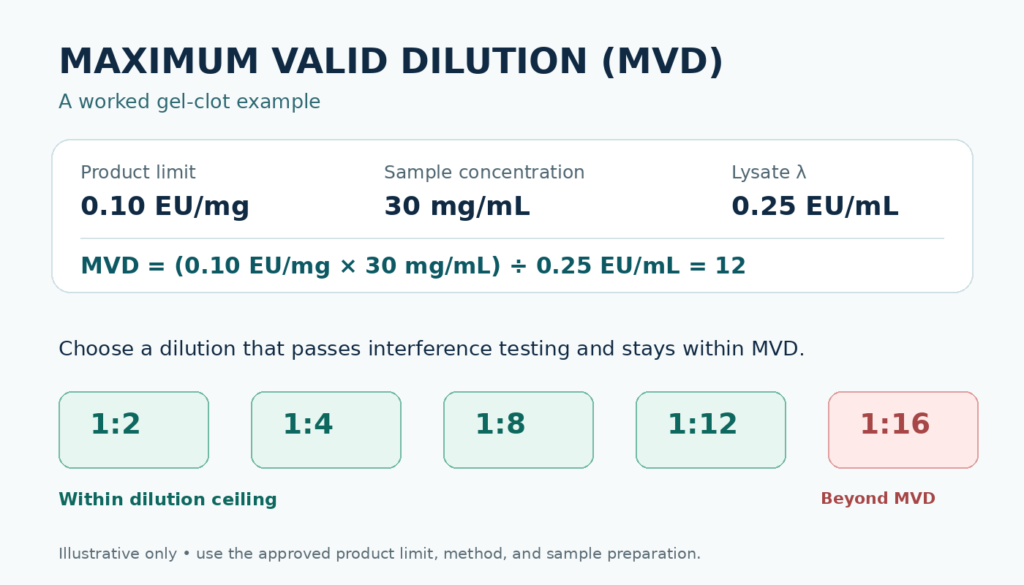
The endotoxin limit is the first input to the maximum valid dilution (MVD). With a limit of 0.5 EU/mg, a sample solution of 20 mg/mL and a lysate sensitivity of 0.125 EU/mL:
MVD = (0.5 EU/mg × 20 mg/mL) ÷ 0.125 EU/mL = 80
The sample may be diluted up to 1:80, provided the chosen dilution passes the test for interfering factors. The endotoxin limit calculator has a button that opens the MVD calculator with the limit already filled in.
Common calculation mistakes
- Using the usual dose. M must be the maximum recommended dose. A lower dose inflates the limit.
- Ignoring the one-hour rule. For infusions and repeated injections, the dose in the worst single hour is M, not the single-injection dose.
- Using K = 5 for an intrathecal product. Intrathecal products use 0.2 EU/kg.
- Forgetting to divide by body weight. A per-patient dose used as if it were per kg makes M far too large and the limit far too strict.
- Mismatched units. A limit in EU/mg must be paired with a concentration in mg/mL when calculating MVD, and a limit in EU/mL with mL/mL.
- Not checking every route and regimen. If a product can be given by more than one route, dose or infusion time, calculate each and use the lowest limit as the specification.
- Overriding an approved limit. A monograph or registered specification takes precedence over a K/M calculation.
Frequently Asked Questions (FAQs)
What is the formula for endotoxin limit?
For parenteral products, USP <85> uses EL = K/M, where K is the threshold pyrogenic dose per kg body weight and M is the maximum recommended dose per kg given in one hour.
What is the value of K in the endotoxin limit formula?
K is 5 USP-EU/kg of body weight for any route other than intrathecal and 0.2 USP-EU/kg for intrathecal products. For formulations dosed per square metre of body surface (usually anticancer products), K is 100 EU/m².
What does M mean in K/M?
M is the maximum recommended bolus dose per kg of body weight. For frequent injections or continuous infusion, it is the maximum total dose given in a single hour.
How is the endotoxin limit calculated for radiopharmaceuticals?
USP <85> uses 175/V for radiopharmaceuticals that are not given intrathecally and 14/V for intrathecal ones, where V is the maximum recommended dose in mL. The result is in EU/mL.
Which units can an endotoxin limit have?
USP <85> expresses limits as EU/mg, EU/mL or EU/Unit of biological activity. The unit follows from how the dose M is expressed.
What body weight should I use?
USP <85> does not specify one. 70 kg (US adult) and 60 kg (Japanese adult) are widely used rules of thumb. For paediatric use, base the calculation on the smallest patient in the target group, and state the weight in your specification.
How is the endotoxin limit used to calculate MVD?
MVD = (endotoxin limit × concentration of sample solution) ÷ λ. A higher limit allows a greater dilution, which can help overcome product interference.
Related guides and tools: endotoxin units (EU) explained, lysate sensitivity confirmation, the lysate sensitivity calculator and sterility testing (USP <71>).
References
- USP <85>, Bacterial Endotoxins Test.
- FDA, Pyrogen and Endotoxins Testing: Questions and Answers.
- Associates of Cape Cod, Calculating Endotoxin Limits (technical note).
The numerical examples are illustrative. Use the current product specification, pharmacopoeial text and approved method for release testing.

Noman Iftikhar is a microbiologist with an MPhil in Microbiology and professional experience in pharmaceutical microbiology. His work includes sterility testing, bacterial endotoxin testing, microbial limit testing, environmental monitoring, and microbiological quality control. Through MicrobiologyPedia, he shares practical, evidence-based guidance to help microbiology students and laboratory professionals understand testing procedures, laboratory practices, and quality standards.

Pingback: Maximum Valid Dilution (MVD): Formula and Worked Example