

A cleanroom grade and an ISO cleanroom class answer different questions. ISO 14644-1 tells you how many airborne particles a room contains at a stated occupancy state. A GMP grade (A, B, C or D) tells you which stage of sterile manufacturing that room is fit for, and it brings microbiological limits, gowning, monitoring and requalification rules with it. The two systems share the same particle numbers at several points, which is why they are so often presented as interchangeable. They are not.
This guide sets out what each system requires, where the numbers match, and where they deliberately differ. The pharmaceutical requirements are taken from EU GMP Annex 1 (2022), which PIC/S and WHO have adopted as harmonised text, with the US FDA position shown alongside for readers working to US expectations.
Quick answer: ISO class for each GMP grade
| GMP grade | ISO class at rest | ISO class in operation | Typical use |
|---|---|---|---|
| Grade A | ISO 5 | ISO 5 | Critical zone: filling, open sterile product |
| Grade B | ISO 5 | ISO 7 | Background for Grade A in aseptic processing |
| Grade C | ISO 7 | ISO 8 | Less critical clean stages, e.g. solution preparation |
| Grade D | ISO 8 | Not predetermined (set by the manufacturer) | Support and preparation areas |
ISO 14644-1 classifies air cleanliness only, in nine classes from ISO 1 (cleanest) to ISO 9 (see the full guide to ISO 14644-1 cleanroom classification). GMP grades add microbiological limits, gowning, monitoring and requalification rules. The number of particle sampling locations for classification can be found with the ISO 14644 sampling location calculator.
What is a cleanroom?
A cleanroom is a room in which the concentration of airborne particles is controlled and classified, and which is designed, built and operated to limit the introduction, generation and retention of particles. In pharmaceutical manufacturing the concern is wider than “dust”: the particles that matter most are the ones that carry viable microorganisms, and the people working in the room are their main source.
Cleanroom control rests on a few engineering principles that recur throughout this guide:
- HEPA-filtered supply air that dilutes or sweeps away particles generated in the room.
- Airflow pattern: unidirectional (“laminar”) flow over critical zones, and turbulent mixing with high air-change rates in background rooms.
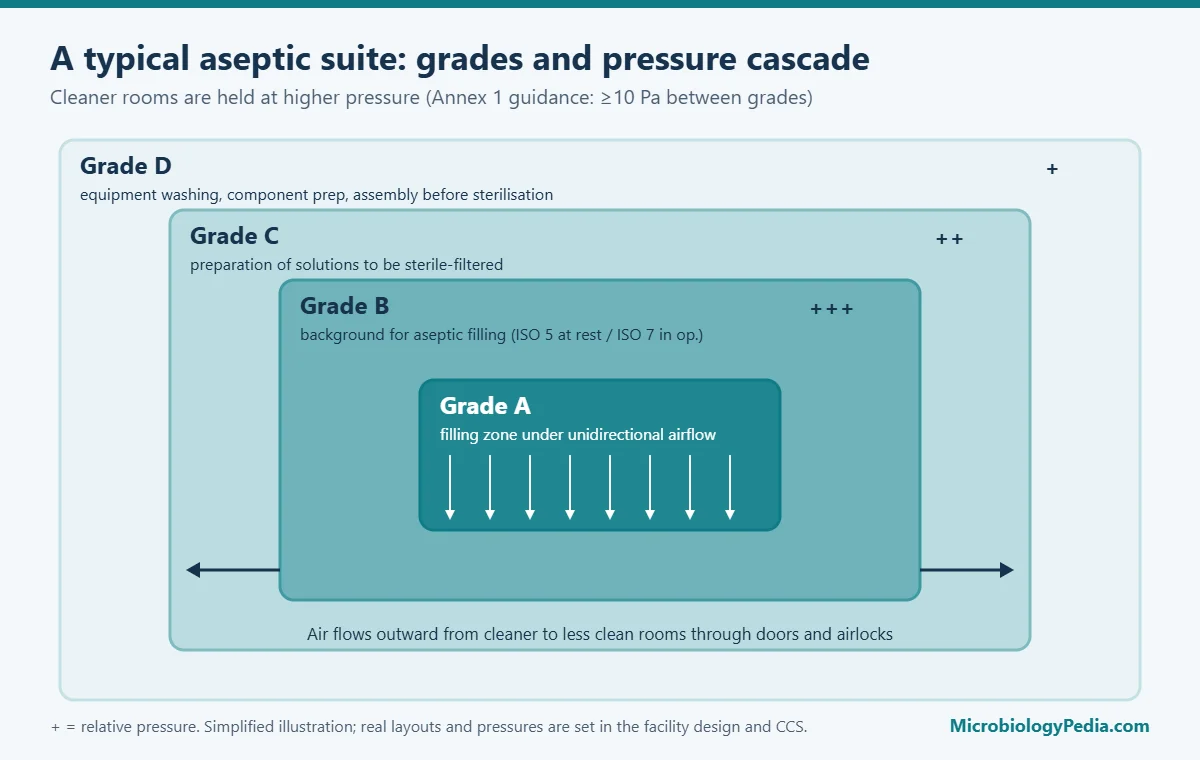
- Pressure cascade: cleaner rooms are held at a higher pressure than less clean adjacent rooms, so air flows outward.
- Behaviour and gowning: slow, minimal movement and garments that contain the particles shed by the body.
Why cleanroom classification matters in sterile manufacturing
Sterile products such as injections, ophthalmic preparations and irrigation solutions cannot rely on end-product testing to prove sterility. The sterility test examines only a small sample and can detect only gross contamination. Assurance therefore has to be built into the process, and the manufacturing environment is one of its foundations.
Classification gives two things: an objective, repeatable measure of air cleanliness at qualification, and a baseline against which routine environmental monitoring is trended. Particles are measured because they are quick to count in real time. Viable organisms are measured separately because a low particle count does not prove that the few particles present are sterile.
ISO cleanroom classification vs GMP grades: the core difference
| Aspect | ISO 14644-1:2015 | GMP grades (EU/PIC/S/WHO Annex 1) |
|---|---|---|
| Type of document | Voluntary international standard | GMP guidance applied by regulators during inspection |
| Industries | All (semiconductors, optics, medical devices, pharma) | Sterile medicinal products (principles may be applied more widely) |
| What is classified | Airborne particle concentration only | Particles plus microbiological contamination, operations, gowning |
| Particle sizes | Any of ≥0.1 to ≥5 µm, chosen by the user | ≥0.5 µm and ≥5 µm |
| Occupancy states | As-built, at rest or operational (user specifies) | At rest and in operation, both required |
| Microorganisms | Outside scope | Action limits for air, settle plates, contact plates and gloves |
| Linked to process steps | No | Yes, each grade is tied to specific operations |
The practical consequence: an ISO certificate alone does not show that a room is suitable for aseptic processing, and a GMP grade cannot be stated without also specifying the occupancy state.
ISO 14644-1 cleanroom classes 1 to 9
ISO 14644-1:2015, Cleanrooms and associated controlled environments – Part 1: Classification of air cleanliness by particle concentration, defines nine classes. Each class sets the maximum permitted concentration of particles equal to or larger than one or more threshold sizes. The concentrations are cumulative: the ≥0.3 µm figure for ISO Class 5 includes every particle of 0.3 µm and above.
| ISO Class | ≥0.1 µm | ≥0.2 µm | ≥0.3 µm | ≥0.5 µm | ≥1 µm | ≥5 µm |
|---|---|---|---|---|---|---|
| 1 | 10 | – | – | – | – | – |
| 2 | 100 | 24 | 10 | – | – | – |
| 3 | 1 000 | 237 | 102 | 35 | – | – |
| 4 | 10 000 | 2 370 | 1 020 | 352 | 83 | – |
| 5 | 100 000 | 23 700 | 10 200 | 3 520 | 832 | – |
| 6 | 1 000 000 | 237 000 | 102 000 | 35 200 | 8 320 | 293 |
| 7 | – | – | – | 352 000 | 83 200 | 2 930 |
| 8 | – | – | – | 3 520 000 | 832 000 | 29 300 |
| 9 | – | – | – | 35 200 000 | 8 320 000 | 293 000 |
Maximum particles per m³. A dash means the standard does not apply a limit at that size, either because the concentration is too high to be meaningful or because counts are too low for statistically sound classification. ISO Class 9 applies to the operational state only.
Points that are frequently misreported:
- ISO Class 5 has no ≥5 µm limit. The 1999 edition listed 29 particles/m³; the 2015 edition removed it because so few large particles are present that sampling cannot classify them reliably. Where a ≥5 µm limit is needed, the standard offers the M descriptor for macroparticles.
- Classification is a defined test, not continuous monitoring. ISO 14644-1 sets the minimum number of sampling locations from the room area (use the ISO 14644 sampling location calculator) and requires every location to meet the class limit. Ongoing monitoring is the subject of ISO 14644-2.
- The occupancy state must be stated. “ISO 7” on its own is incomplete; “ISO 7, in operation, ≥0.5 µm” is a classification.
- Pharmaceutical facilities use a narrow band. Sterile manufacturing works mainly in ISO 5, 7 and 8 conditions; ISO 6 appears as an intermediate state in some designs.
The withdrawn US Federal Standard 209E used imperial classes based on particles per cubic foot. The FDA’s 2004 aseptic processing guidance still prints the old names alongside the ISO designations: Class 100 is ISO 5, Class 10 000 is ISO 7 and Class 100 000 is ISO 8.
The classification test method, class formula, occupancy states and retest intervals are covered step by step in the ISO 14644-1 cleanroom classification guide.
Pharmaceutical cleanroom grades A, B, C and D
EU GMP Annex 1 (clause 4.4) defines four grades by the risk of the operations performed in them. The 2022 revision adds the concept of first air: filtered air that has not been interrupted by anything between the filter and the exposed product.
Grade A: the critical zone
Grade A is the critical zone for high-risk operations: the aseptic processing line, filling zone, stopper bowls, open primary packaging, and aseptic connections made under first air. It is normally provided by localised unidirectional airflow within a restricted access barrier system (RABS) or an isolator. Annex 1 gives a guidance air speed of 0.36–0.54 m/s at the working position, and the unidirectional flow must be demonstrated by airflow visualisation studies. The FDA guidance refers to a velocity of about 0.45 m/s (90 ft/min) for critical areas; the two figures overlap but are not identical.
Grade B: the background for aseptic work
Grade B is the background cleanroom for a Grade A zone during aseptic preparation and filling, when Grade A is not an isolator. It must meet ISO 5 particle limits at rest but is allowed ISO 7 levels in operation, because operators are present. In practice the Grade B room is where gowning discipline, intervention control and material transfer most often decide whether the Grade A zone stays clean.
Grade C: less critical clean stages
Grade C is used for less critical stages, typically preparation of solutions that will be sterile-filtered, and for filling of products that will be terminally sterilised. It is also one possible background for an isolator.
Grade D: preparation and support
Grade D supports the earliest clean stages: cleaning of equipment, handling of components after washing, assembly of components before sterilisation, and preparation of solutions for terminally sterilised products. Annex 1 does not set Grade D in-operation particle limits; the manufacturer sets them from risk assessment and routine data.
Particle limits for classification (Annex 1, Table 1)
| Grade | ≥0.5 µm at rest | ≥0.5 µm in operation | ≥5 µm at rest | ≥5 µm in operation |
|---|---|---|---|---|
| A | 3 520 | 3 520 | Not specified (a) | Not specified (a) |
| B | 3 520 | 352 000 | Not specified (a) | 2 930 |
| C | 352 000 | 3 520 000 | 2 930 | 29 300 |
| D | 3 520 000 | Not predetermined (b) | 29 300 | Not predetermined (b) |
Maximum total particles per m³ for cleanroom classification. (a) Classification including ≥5 µm particles may be considered where indicated by the contamination control strategy (CCS) or historical trends. (b) For Grade D, in-operation limits are set by the manufacturer from risk assessment and routine data. Source: EU GMP Annex 1 (2022), clause 4.27, Table 1.
Annex 1 tells you to follow ISO 14644-1 for the number and position of sampling locations, and requires classification in both the “at rest” state (installation complete, equipment operating, no personnel) and the “in operation” state (the defined operating mode with the specified number of personnel, which may be simulated).
Main comparison: ISO classes vs Grades A, B, C and D
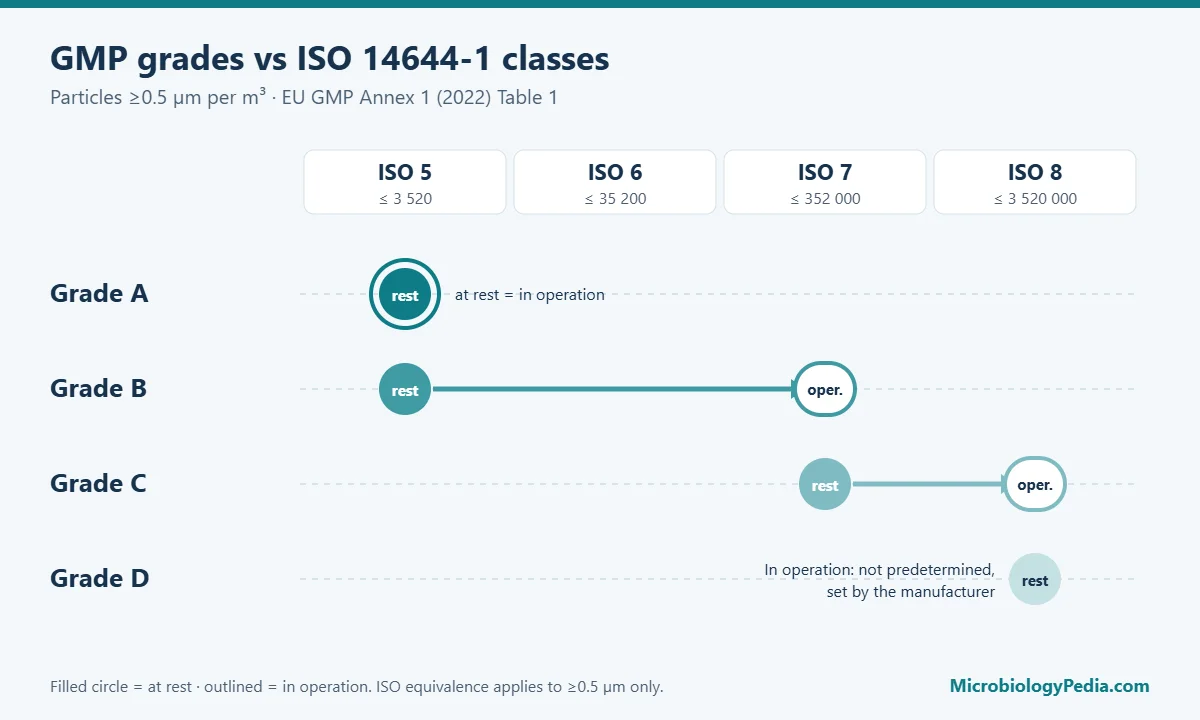
| Parameter | Grade A | Grade B | Grade C | Grade D |
|---|---|---|---|---|
| ISO class equivalent at rest (≥0.5 µm) | ISO 5 | ISO 5 | ISO 7 | ISO 8 |
| ISO class equivalent in operation (≥0.5 µm) | ISO 5 | ISO 7 | ISO 8 | Not predetermined |
| ≥0.5 µm limit, at rest / in operation (per m³) | 3 520 / 3 520 | 3 520 / 352 000 | 352 000 / 3 520 000 | 3 520 000 / set by manufacturer |
| ≥5 µm limit for classification (per m³) | Not specified | Not specified / 2 930 | 2 930 / 29 300 | 29 300 / set by manufacturer |
| ≥5 µm limit for monitoring (per m³) | 29 / 29 | 29 / 2 930 | 2 930 / 29 300 | 29 300 / set by manufacturer |
| Viable air action limit (CFU/m³) | No growth | 10 | 100 | 200 |
| Typical applications | Aseptic filling, open sterile components, aseptic connections | Background to Grade A; staging protected items for transfer into A | Preparation of solutions to be filtered; filling of terminally sterilised products | Equipment cleaning; component handling and assembly before sterilisation |
| Environmental monitoring | Continuous particle monitoring; continuous viable monitoring during critical processing; every isolate identified to species | Frequent particle and viable monitoring; personnel gloves and gown on exit; isolates identified to species | Risk-based particle and viable monitoring | Risk-based particle and viable monitoring |
| Maximum requalification interval | 6 months | 6 months | 12 months | 12 months |
Sources: EU GMP Annex 1 (2022) Tables 1, 3, 4, 5 and 6, clauses 4.27 and 4.32, and Section 9.
Three conclusions follow from the table:
- “Grade A = ISO 5” holds only for ≥0.5 µm. Grade A also has a ≥5 µm monitoring limit of 29/m³ and a no-growth microbial expectation, neither of which exists in ISO 14644-1.
- Grade B is two ISO classes at once. ISO 5 at rest and ISO 7 in operation. Calling Grade B “ISO 7” without the state is wrong; calling it “ISO 5” without the state is incomplete.
- An ISO 8 room is not automatically Grade D. It also needs the Annex 1 microbial limits, gowning, CCS coverage and requalification interval.
Classification limits vs routine monitoring limits
Annex 1 separates classification (a qualification test performed at defined intervals) from environmental monitoring (the ongoing programme that shows the room stays in control). The particle limits for each are printed in different tables, and the difference is easy to miss:
- Table 1 (classification) sets no ≥5 µm limit for Grade A, or for Grade B at rest.
- Table 5 (monitoring) sets a ≥5 µm action limit of 29/m³ for Grade A in both states and for Grade B at rest.
Large particles are rare in a well-functioning unidirectional airflow zone, so a single count can be a false signal from electrical noise, stray light or coincidence. Annex 1 accepts that an occasional ≥5 µm count may be a false count, but consecutive or regular low-level counts are a possible sign of contamination and must be investigated.
Annex 1 also expects the at-rest limits to be met after a short “clean-up” period following operations, with a guidance value of less than 20 minutes, which should be established during qualification.
PIC/S GMP vs WHO GMP vs EU GMP: cleanroom requirements
The three pharmaceutical frameworks were developed together, and their sterile manufacturing texts are now harmonised. They are still separate documents with different legal status, versions and adoption routes.
| Item | EU GMP Annex 1 | PIC/S GMP Guide, Annex 1 | WHO TRS 1044, Annex 2 | US FDA aseptic guidance |
|---|---|---|---|---|
| Current document | EudraLex Vol. 4, Annex 1, published August 2022 | PE 009-18 (current guide, September 2026); Annex 1 revised in PE 009-17 | WHO GMP for sterile pharmaceutical products, TRS 1044 Annex 2 (2022) | Sterile Drug Products Produced by Aseptic Processing – cGMP (September 2004) |
| In force since | 25 August 2023 (point 8.123 from 25 August 2024) | 25 August 2023 for PIC/S; national adoption dates vary | Applies where national authorities adopt it | 2004; non-binding guidance under 21 CFR 210/211 |
| Replaces | 2008 Annex 1 | Previous PIC/S Annex 1 | TRS 961 Annex 6 (2011) | 1987 aseptic processing guideline |
| Grades | A, B, C, D | A, B, C, D | A, B, C, D | ISO 5, 6, 7, 8 (no letter grades) |
| Particle classification limits | Table 1 | Same values | Same values | ≥0.5 µm only, per ISO class |
| Microbial limits | Table 6 action limits; any Grade A growth investigated | Same | Same | Action levels per ISO class (Table 1) |
| Contamination Control Strategy | Required | Required | Required | Not a named requirement |
| Requalification | ≤6 months (A/B), ≤12 months (C/D) | Same | Same | Not fixed; risk- and data-based |
| Interpretation documents | Q&A from EMA/national inspectorates | PI 058-1 interpretation of Annex 1 (October 2026) | WHO inspector guidance | FDA inspection practice |
What differs in practice is not the numbers but the scope of application and legal route:
- EU: Annex 1 is applied directly to manufacturers supplying the EU and EEA, including non-EU sites exporting there.
- PIC/S: each participating authority (for example Australia’s TGA, Singapore’s HSA, Health Canada) transposes the Annex into its own GMP framework, sometimes with phased dates. PIC/S states that its Annex 1 is identical to the EU text apart from minor differences.
- WHO: the guideline is a reference for national regulators and for WHO prequalification. It has force only where a country adopts it.
- US: the FDA has not adopted Annex 1. US sites follow the 2004 guidance and 21 CFR 211, and many also comply with Annex 1 because they supply EU or PIC/S markets.
How the FDA guidance maps to Annex 1
| ISO class (FDA Table 1) | ≥0.5 µm per m³ | Active air action level (CFU/m³) | Settle plate action level (90 mm, CFU/4 h) | Nearest Annex 1 grade |
|---|---|---|---|---|
| ISO 5 (Class 100) | 3 520 | 1 | 1 | Grade A (in operation) |
| ISO 6 (Class 1 000) | 35 200 | 7 | 3 | No direct equivalent |
| ISO 7 (Class 10 000) | 352 000 | 10 | 5 | Grade B in operation / Grade C at rest |
| ISO 8 (Class 100 000) | 3 520 000 | 100 | 50 | Grade C in operation / Grade D at rest |
FDA classifications are based on measurements made near exposed materials during activity. The FDA notes that samples from ISO 5 environments should normally yield no microbiological contaminants. Source: FDA (2004), Table 1.
Two practical differences matter for US sites: the FDA classifies the critical area in operation, with particle counts taken normally not more than one foot from the work site; and it recommends a pressure differential of at least 10–15 Pa between rooms of different classification, where Annex 1 gives a guidance value of at least 10 Pa between adjacent grades.
Viable and non-viable environmental monitoring
Methods, limits, sampling frequency and excursion handling are covered in detail in the guide to environmental monitoring in pharmaceutical cleanrooms.
Environmental monitoring (EM) shows that the cleanroom stays in the state demonstrated at qualification. Annex 1 requires a monitoring programme defined in the CCS and based on risk assessment, covering total particles, viable particles, personnel, and room parameters such as pressure differential.
Non-viable (total) particle monitoring
- Grade A: continuous monitoring for ≥0.5 µm and ≥5 µm particles for the full duration of critical processing, including equipment assembly.
- Grade B: a similar system is recommended, at a frequency that captures changes in contamination levels and system deterioration.
- Grades C and D: monitoring frequency based on quality risk management.
Viable monitoring methods
- Active air sampling: a measured volume of air is impacted onto agar; results in CFU/m³.
- Settle plates (passive): 90 mm plates exposed for up to 4 hours; in Grades A and B they should be exposed for the duration of operations and changed as required.
- Surface monitoring: 55 mm contact plates on flat surfaces, swabs on irregular ones; Annex 1 expects surfaces to be monitored at the end of an operation.
- Personnel monitoring: glove prints (5 fingers, both hands) and gown samples. Personnel in Grade B are monitored each time they leave, and gloves are checked after critical interventions.
| Grade | Air sample (CFU/m³) | Settle plate, 90 mm (CFU/4 h) | Contact plate, 55 mm (CFU/plate) | Glove print, 5 fingers (CFU/glove) |
|---|---|---|---|---|
| A | No growth | No growth | No growth | No growth |
| B | 10 | 5 | 5 | 5 |
| C | 100 | 50 | 25 | – |
| D | 200 | 100 | 50 | – |
Maximum action limits for viable particle contamination. For Grade A, any growth should result in an investigation. Contact plate limits apply to equipment, room and gown surfaces within Grades A and B; routine gown monitoring is not normally required in Grades C and D. Source: EU GMP Annex 1 (2022), clause 9.30, Table 6.
Alert levels, action limits and identification
- Action limits in Tables 5 and 6 are maximums. Manufacturers may set tighter ones, and any excursion requires a root-cause investigation.
- Alert levels are set by the manufacturer from qualification results and trend data, and should be reviewed periodically. Annex 1 requires alert levels for Grade A total particles and for all monitoring in Grades B, C and D.
- Identification: microorganisms detected in Grade A and B areas should be identified to species level, and their impact on each implicated batch assessed (clause 9.31).
- Trending: repeated recoveries below the action limit, a change in microflora or a rising number of excursions can indicate loss of control even when no single result fails.
US practice often adds contamination recovery rates from USP <1116>, which assesses the percentage of samples showing any growth rather than the CFU count. Its suggested initial rates are below 0.1% for isolators and closed RABS, below 1% for ISO 5, below 3% for ISO 6, below 5% for ISO 7 and below 10% for ISO 8. USP <1116> is an informational chapter, not a mandatory limit set.
Cleanroom grades in practical pharmaceutical operations
Annex 1 gives examples of the grade expected for each operation. They are examples, not a closed list, and the CCS must justify the final choice.
| Operation | Typical grade | Why |
|---|---|---|
| Aseptic filling, stoppering, transfer of partially stoppered vials, loading of a lyophiliser | Grade A (Grade B background, or isolator) | Product and sterile container surfaces are exposed |
| Aseptic assembly of filling equipment; connections after sterilisation (unless intrinsically aseptic) | Grade A | Sterile product-contact surfaces are open |
| Removal and cooling of unprotected items from sterilisers | Grade A | Sterilised items exposed before closure |
| Staging or conveying wrapped sterile items for transfer into Grade A | Grade B | Items are protected but enter the critical zone next |
| Preparation of solutions to be sterile-filtered, including sampling and dispensing | Grade C | Bioburden must be controlled before the sterilising filter |
| Filling of products to be terminally sterilised | Grade C (Grade A if unusually at risk) | Terminal sterilisation follows, so risk is lower |
| Preparation of solutions and components for products to be terminally sterilised | Grade D (Grade C if unusually at risk) | Bioburden control ahead of terminal sterilisation |
| Cleaning of equipment; handling of components after washing; assembly before sterilisation | Grade D | Items will be sterilised afterwards |
| Assembly of closed, sterilised single-use systems using intrinsic aseptic connectors | Grade D | The system itself protects the sterile pathway |
Source: EU GMP Annex 1 (2022), Tables 3 and 4.
The logic behind every row is the same: the grade follows the exposure. The closer an operation is to an open sterile product or sterile product-contact surface, and the fewer sterilising steps that follow it, the higher the grade.
This is also why endotoxin control and bioburden control are linked to cleanroom design. Grades C and D limit the microbial load reaching a sterilising filter or a terminal sterilisation cycle, which is the same load that would otherwise contribute bacterial endotoxins to the finished product.
Gowning and personnel by grade
People are the largest contamination source in a cleanroom, so Annex 1 links gowning to grade:
- Grade D: hair and any beard covered; a general protective suit; appropriately disinfected shoes or overshoes.
- Grade C: hair and beard covered; a single- or two-piece trouser suit gathered at the wrists with a high neck; appropriately disinfected shoes or overshoes; shed no fibres or particles.
- Grades A/B: sterile headgear enclosing all hair and facial hair; sterile face mask and eye covering; sterilised, powder-free gloves; sterilised footwear; a sterile coverall with trouser legs tucked into the footwear and sleeves into the gloves.
Operators entering Grade B must be qualified, which includes a gowning assessment and participation in a successful aseptic process simulation (media fill).
Cleanroom qualification and requalification
Qualification shows that a cleanroom or clean air equipment is fit for its intended use. Annex 1 lists the minimum tests: installed filter leak and integrity testing, airflow volume and velocity measurement, air pressure difference measurement, airflow direction and visualisation, particle classification, microbial contamination at qualification (Annex 1 Table 2), temperature and humidity, and recovery testing.
Requalification must be performed at least every 6 months for Grades A and B and every 12 months for Grades C and D (clause 4.32). It is also required after remedial action for an out-of-compliance condition, and after significant changes to the HVAC system, room layout or maintenance such as filter replacement.
Contamination Control Strategy (CCS)
The 2022 revision of Annex 1 made the Contamination Control Strategy the document that ties everything above together. The CCS describes how the facility controls microbial, endotoxin/pyrogen and particle contamination across:
- premises and HVAC;
- equipment and utilities, including water systems;
- personnel and gowning;
- raw materials and components;
- cleaning, disinfection and sterilisation;
- monitoring;
- the effectiveness of these controls.
Cleanroom grade, monitoring locations, alert levels and requalification frequencies should all be traceable to the risk assessment in the CCS rather than copied from a table.
Frequently Asked Questions (FAQs)
What is the difference between ISO Class 5 and Grade A?
ISO Class 5 is a particle classification: no more than 3 520 particles ≥0.5 µm per m³. Grade A meets that limit both at rest and in operation, but it also carries a ≥5 µm monitoring limit of 29/m³, a no-growth expectation for viable monitoring, continuous monitoring during critical processing, unidirectional airflow and strict gowning. Every Grade A zone is ISO 5; not every ISO 5 zone is Grade A.
Is ISO Class 7 equivalent to Grade B?
Only in operation. A Grade B room must meet ISO 5 particle limits at rest and ISO 7 limits in operation. A room that meets ISO 7 at rest does not meet Grade B.
What ISO class is Grade C?
Grade C corresponds to ISO 7 at rest and ISO 8 in operation for particles ≥0.5 µm.
What ISO class is Grade D?
Grade D corresponds to ISO 8 at rest. Annex 1 does not predetermine in-operation limits; the manufacturer sets them from risk assessment and routine data.
What is the difference between ISO 14644 and EU GMP Annex 1?
ISO 14644-1 is a voluntary, cross-industry standard that classifies air cleanliness by particle concentration only. Annex 1 is GMP guidance for sterile medicinal products. It uses ISO 14644-1 methods for particle classification and adds two occupancy states, microbial action limits, gowning, process-specific grades, requalification intervals and the Contamination Control Strategy.
What is the difference between “at rest” and “in operation”?
“At rest” is the state with installation complete, equipment operating and no personnel present. “In operation” is the defined operating mode with the specified number of personnel working, which can be real or simulated. Both states must be qualified under Annex 1.
Are viable particle limits the same as non-viable particle limits?
No. Non-viable (total) particle limits count all particles in particles/m³. Viable limits count microorganisms that grow on culture media in CFU, using air samples, settle plates, contact plates and glove prints. A room can meet its particle limit and still fail its viable limit.
What is the purpose of Grade B in aseptic manufacturing?
Grade B is the background cleanroom that surrounds a Grade A zone when the Grade A zone is not an isolator. It limits the particles and microorganisms that can reach the critical zone, and it is where operators, materials and interventions are controlled before anything enters Grade A.
How often must GMP cleanrooms be requalified?
Under Annex 1, the maximum interval is 6 months for Grades A and B and 12 months for Grades C and D, with additional requalification after significant changes or remedial action.
Does the FDA use Grades A, B, C and D?
No. The FDA’s 2004 aseptic processing guidance uses ISO classes (ISO 5, 6, 7 and 8) with its own recommended microbial action levels. US manufacturers supplying the EU or PIC/S markets usually also design to Annex 1 grades.
References
- International Organization for Standardization. ISO 14644-1:2015 Cleanrooms and associated controlled environments – Part 1: Classification of air cleanliness by particle concentration. Geneva: ISO; 2015.
- European Commission. EudraLex Volume 4, Annex 1: Manufacture of Sterile Medicinal Products. Brussels; August 2022 (in force 25 August 2023).
- Pharmaceutical Inspection Co-operation Scheme. PIC/S news: entry into force of revised Annex 1 (PE 009-17), PE 009-18 and PI 058-1. Geneva; 2023–2026.
- World Health Organization. TRS 1044, Annex 2: WHO good manufacturing practices for sterile pharmaceutical products. Geneva: WHO; 2022.
- US Food and Drug Administration. Guidance for Industry: Sterile Drug Products Produced by Aseptic Processing – Current Good Manufacturing Practice. Silver Spring, MD: FDA; September 2004.
- Health Canada. Annex 1 to the GMP guide – Manufacture of sterile drugs (GUI-0119): Environmental and process monitoring. Ottawa; 2024.
- United States Pharmacopeia. General Chapter <1116> Microbiological Control and Monitoring of Aseptic Processing Environments. Rockville, MD: USP (subscription).
This article is for education and professional reference. Always apply the current version of the regulations and standards that govern your site, your Contamination Control Strategy and your validated procedures.

Noman Iftikhar is a microbiologist with an MPhil in Microbiology and professional experience in pharmaceutical microbiology. His work includes sterility testing, bacterial endotoxin testing, microbial limit testing, environmental monitoring, and microbiological quality control. Through MicrobiologyPedia, he shares practical, evidence-based guidance to help microbiology students and laboratory professionals understand testing procedures, laboratory practices, and quality standards.