An endotoxin unit (EU) is the unit used to report bacterial endotoxins in the bacterial endotoxins test (BET). It measures endotoxin activity in the LAL or recombinant reagent, compared with a reference standard endotoxin, rather than the mass of endotoxin present. Endotoxin limits, lysate sensitivity (λ) and test results are all expressed in EU.
Endotoxin units at a glance
| Item | Summary |
|---|---|
| What an EU measures | Endotoxin activity relative to the reference standard endotoxin (RSE) |
| Reference standard | USP Endotoxin RS, prepared from Escherichia coli O113:H10 and calibrated to the WHO International Standard |
| EU and IU | One USP Endotoxin Unit (EU) equals one International Unit (IU) of endotoxin |
| Approximate mass equivalent | For the current reference endotoxin, about 10 EU per ng; other endotoxins differ |
| Common units | EU/mL (results, λ), EU/mg or EU/unit (product limits), EU/kg (threshold dose K) |
Why endotoxin is reported in units, not nanograms
Endotoxins from different bacteria, and even different preparations from the same species, have different biological activity per nanogram. A mass result would not tell how pyrogenic a sample is. The EU solves this by expressing every result as the activity equal to that of a defined amount of a single reference standard.
When the FDA first standardized the test, one EU was defined as the activity of 0.2 ng of the reference endotoxin EC-2 (5 EU/ng). Later reference lots were assigned their potency directly in EU; the USP Endotoxin RS is supplied with a stated number of EU per vial, and the current reference endotoxin works out at about 10 EU per ng.
EU and IU: are they the same?
Yes. USP <85> states that one USP Endotoxin Unit (EU) is equal to one International Unit (IU) of endotoxin. The European Pharmacopoeia (2.6.14) expresses endotoxin in IU and gives the same equivalence, so results and limits can be compared directly.
Reference standard and control standard endotoxin
- Reference Standard Endotoxin (RSE): the official standard (USP Endotoxin RS), with a defined potency in EU per vial.
- Control Standard Endotoxin (CSE): a working endotoxin preparation calibrated against the RSE for a specific lysate lot. Its potency is stated on the certificate of analysis in EU per ng or EU per vial.
Because CSE potency is specific to each CSE and lysate lot combination, the certificate for the lots in use must be applied when standards are prepared.
Where endotoxin units are used
| Quantity | Typical unit | Example |
|---|---|---|
| Threshold pyrogenic dose (K) | EU/kg body weight | K = 5 EU/kg; 0.2 EU/kg for intrathecal use |
| Product endotoxin limit | EU/mg, EU/mL or EU/unit | 0.5 EU/mg |
| Body-surface dosing | EU/m² | K = 100 EU/m² |
| Lysate sensitivity (λ) | EU/mL | 0.125 EU/mL |
| Test result | EU/mL of sample or EU per product unit | <0.25 EU/mL |
Worked examples
1. Endotoxin limit in EU/mg
A drug has a maximum dose of 10 mg/kg (route other than intrathecal, so K = 5 EU/kg). EL = K ÷ M = 5 ÷ 10 = 0.5 EU/mg.
2. Converting EU/mg to EU/mL
If the product solution contains 10 mg/mL, the limit per mL is 0.5 EU/mg × 10 mg/mL = 5 EU/mL.
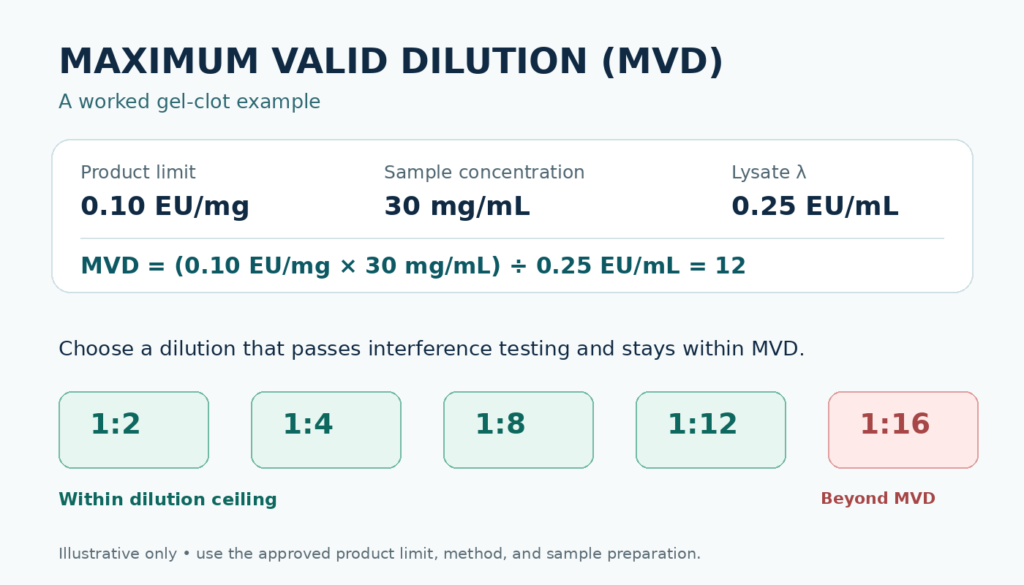
3. Maximum valid dilution
With λ = 0.125 EU/mL: MVD = (0.5 EU/mg × 10 mg/mL) ÷ 0.125 EU/mL = 40, so the sample can be diluted up to 1:40. The endotoxin limit calculator and MVD calculator do these steps automatically.
To prepare endotoxin standard dilutions in EU/mL (for example 0.5 EU/mL from a 50 EU/mL stock), use the dilution calculator.
4. What does a result in EU mean in nanograms?
A result of 0.5 EU/mL has the same activity as about 0.05 ng/mL of the reference E. coli endotoxin (at about 10 EU/ng). It does not mean that 0.05 ng/mL of endotoxin is actually present, because endotoxin from other bacteria can be more or less active per nanogram.
Common mistakes with endotoxin units
- Converting EU results to nanograms and treating them as a true mass.
- Mixing up EU/mL of the test solution with EU per mg or per unit of product.
- Using a CSE potency from a certificate for a different lysate lot.
- Forgetting to apply the dilution factor when reporting a result.
- Assuming EU and IU differ; under USP <85> they are equal.
Frequently Asked Questions (FAQs)
What is an endotoxin unit (EU)?
A unit of endotoxin activity measured against the reference standard endotoxin, used to report BET results and limits.
How many nanograms is one EU?
There is no fixed conversion. For the current reference endotoxin it is about 0.1 ng per EU (about 10 EU per ng), but other endotoxins have different activity per nanogram.
Is 1 EU equal to 1 IU?
Yes. USP <85> states that one USP Endotoxin Unit equals one International Unit of endotoxin.
What does EU/mL mean?
The endotoxin activity in each millilitre of the solution tested. Lysate sensitivity (λ) is also given in EU/mL; see lysate sensitivity confirmation.
What is the endotoxin limit for parenteral products?
It depends on the dose: EL = K ÷ M, with K = 5 EU/kg (0.2 EU/kg intrathecal). See endotoxin limit calculation (K/M).
References
- USP General Chapter <85> Bacterial Endotoxins Test.
- European Pharmacopoeia 2.6.14 Bacterial Endotoxins.
- U.S. FDA, Guidance for Industry: Pyrogen and Endotoxins Testing: Questions and Answers (2012).
This guide is for education. Use the current official chapters and your approved procedures.

Noman Iftikhar is a microbiologist with an MPhil in Microbiology and professional experience in pharmaceutical microbiology. His work includes sterility testing, bacterial endotoxin testing, microbial limit testing, environmental monitoring, and microbiological quality control. Through MicrobiologyPedia, he shares practical, evidence-based guidance to help microbiology students and laboratory professionals understand testing procedures, laboratory practices, and quality standards.