The Burkholderia cepacia complex (BCC) is a group of about 20 closely related species of Gram-negative, rod-shaped, aerobic, non-fermenting bacteria found in soil and water. In pharmaceutical manufacturing it is one of the most important objectionable microorganisms for non-sterile, water-based products, because it survives in purified water systems, tolerates several preservatives and can cause serious infection in vulnerable patients. USP <60>, official since 1 December 2019, gives the compendial test for its absence.
What is the Burkholderia cepacia complex?
Burkholderia cepacia was first described as Pseudomonas cepacia and was later moved to the genus Burkholderia. What was once treated as a single species is now recognised as a complex of closely related species that cannot be separated reliably by routine phenotypic tests. B. cepacia, B. cenocepacia and B. multivorans are the members met most often in product and clinical work, and they are the three test strains named in USP <60>.
| Characteristic | BCC |
|---|---|
| Gram stain | Gram-negative rods |
| Oxygen requirement | Aerobic |
| Carbohydrate metabolism | Non-fermenting (oxidative) |
| Motility | Motile |
| Spores | None |
| Natural habitat | Soil, water, plant surfaces; man-made wet environments |
| Former name | Pseudomonas cepacia |
Why BCC matters in pharmaceutical manufacturing
BCC organisms are opportunistic pathogens. People with cystic fibrosis, weakened immune systems or mechanical ventilation are at particular risk, and contaminated medicines have been linked to outbreaks in hospitals.
Three properties make the complex a manufacturing problem:
- It lives in water. Purified water systems, hoses, tanks and wet equipment can carry BCC, often in biofilm that resists routine sanitisation.
- It tolerates preservatives. BCC can survive, and sometimes multiply, in products that contain preservatives or other antimicrobial ingredients.
- It is easy to miss. Without an enrichment step and a selective medium, low numbers may not be recovered, and isolates are sometimes misidentified as Pseudomonas or Ralstonia.
An analysis of FDA recall data for 134 non-sterile pharmaceutical products from 1998 to September 2006 found B. cepacia to be the most frequently isolated species, accounting for 22% of those recalls. Recalled products over the years have included antiseptics, oral liquids, nasal sprays and mouthwashes.
What regulators expect
In May 2017 the FDA issued an advisory to manufacturers of non-sterile, water-based drug products, since updated, stating that BCC continues to pose a contamination risk. The advisory reminds manufacturers to:
- establish procedures that prevent objectionable microbial contamination, covering material quality, equipment and facility design, cleaning and maintenance;
- keep water distribution and piping systems sanitary and suitable for use;
- set scientifically sound specifications and test procedures for components (including water), in-process materials and finished products;
- investigate failures and extend the investigation to other batches and products that may be affected.
The FDA recommends using the USP <60> method, after appropriate method verification, to test drug products for BCC. Its 2021 draft guidance, Microbiological Quality Considerations in Non-sterile Drug Manufacturing, sets out a risk-based approach to the same question.
BCC is not one of the specified microorganisms in USP <62>. Whether a BCC isolate is objectionable in a given product is a risk assessment that considers the route of administration, the patient population, the product’s ability to support growth and the number of organisms found. See the microbial limit test guide for how specified and objectionable organisms differ.
USP <60>: test for Burkholderia cepacia complex
USP <60>, Microbiological Examination of Nonsterile Products: Tests for Burkholderia cepacia Complex, became official on 1 December 2019. It is a presence/absence test built on the same principles as USP <62>.
| Step | What is done | Conditions |
|---|---|---|
| 1. Sample preparation | A 1:10 dilution of not less than 1 g (or 1 mL) of product is prepared as in USP <61>, with neutralisation where needed | Product-specific |
| 2. Enrichment | The prepared sample is inoculated into soybean–casein digest broth | 30–35 °C for 48–72 hours |
| 3. Selective isolation | The enrichment is streaked onto Burkholderia cepacia selective agar (BCSA) | 30–35 °C for 48–72 hours |
| 4. Interpretation | Growth on BCSA indicates the possible presence of BCC and is confirmed by identification tests | Product complies if no colonies are present or identification is negative |
The whole test takes 5 to 6 days. Two requirements sit alongside it:
- Growth promotion and indicative properties. Each batch of BCSA is tested with B. cepacia, B. cenocepacia and B. multivorans, in the same way as media for other compendial tests (see growth promotion testing).
- Method suitability. The laboratory shows, for each product, that the three test strains are recovered in the presence of the product, so that preservatives or other ingredients do not mask contamination.
The chapter applies in particular to products for inhalation use and to aqueous preparations for oral, oromucosal, cutaneous or nasal use.
What BCC colonies look like on BCSA
On Burkholderia cepacia selective agar, the possible presence of BCC is indicated by greenish-brown colonies with yellow halos, or white colonies surrounded by a pink-red zone. The colours come from the indicator and dye in the medium.
| What is seen on the plate | Why it happens |
|---|---|
| Yellow halo around the growth | Acid formed when the organism oxidises the carbohydrates in the medium |
| Pink-red zone around the growth | Peptone is used instead of carbohydrate, so no acid is formed |
| Purple to purple-grey colonies | The colonies take up the crystal violet dye |
In a published performance study of the three USP test strains, B. cepacia grew as greenish-brown colonies with yellow halos, while B. cenocepacia and B. multivorans grew as purple colonies with a pink-red zone, were smaller, and needed up to 72 hours. Appearance varies with the strain and the brand of medium, so colour alone never confirms or excludes BCC: any growth on BCSA goes forward to identification.
Identifying a suspect isolate
Colonies on BCSA are presumptive. Confirmation normally follows this sequence:
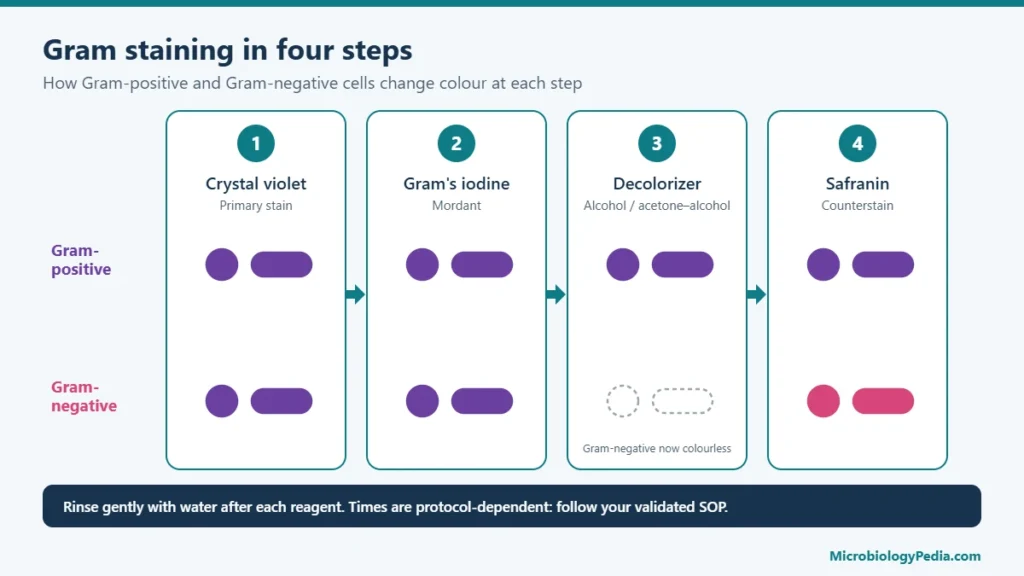
- Gram stain: Gram-negative rods (see Gram stain results of common bacteria).
- Basic biochemical tests: non-lactose-fermenting growth on MacConkey agar; most strains are catalase positive and oxidase positive, although the oxidase reaction can be slow or weak.
- Definitive identification: a validated identification system, MALDI-TOF mass spectrometry, or a molecular method such as PCR or gene sequencing. Phenotypic kits alone can confuse BCC with Pseudomonas, Ralstonia or other Burkholderia species.
Identification to complex level is enough to answer the compendial question. Identification to species level, or strain typing, is used in investigations to link a product isolate to a source such as a water outlet.
Sources of contamination and how to control them
| Source | Typical control |
|---|---|
| Purified water system | Sanitary design with no dead legs, continuous circulation, routine sanitisation, microbial monitoring that includes BCC detection |
| Wet equipment, hoses, tanks | Drain and dry after cleaning; avoid standing water; replace worn hoses and gaskets |
| Raw materials, especially natural or aqueous ones | Supplier qualification and microbial testing of incoming lots |
| Weak or poorly matched preservative system | Preservative efficacy testing during development, including BCC challenge where the risk justifies it |
| Rework and long hold times of bulk | Validated hold times; avoid holding unpreserved aqueous intermediates |
Finished-product testing confirms that controls worked; it does not replace them. A single positive result warrants an investigation of the water system and of other batches made on the same equipment.
Frequently Asked Questions (FAQs)
Is Burkholderia cepacia Gram-positive or Gram-negative?
It is a Gram-negative rod. Because it has an outer membrane containing lipopolysaccharide, it is also a source of endotoxin.
What is the difference between Burkholderia cepacia and the Burkholderia cepacia complex?
B. cepacia is one species. The complex is the group of about 20 closely related species, including B. cepacia, B. cenocepacia and B. multivorans, that routine tests cannot reliably tell apart.
Which products must be tested for BCC?
USP <60> is directed at non-sterile products, especially inhalation products and aqueous preparations for oral, oromucosal, cutaneous or nasal use. The need for testing in a specific product is set by its specification and risk assessment.
How long does the USP <60> test take?
Five to six days: 48–72 hours of enrichment followed by 48–72 hours on selective agar, plus the time needed to identify any colonies.
Is BCC resistant to antibiotics?
BCC bacteria are intrinsically resistant to several antibiotic classes, including polymyxins and aminoglycosides. Treatment of an infection is a clinical decision based on susceptibility testing.
Can BCC grow in preserved products?
Yes. BCC has been recovered from products that contained preservatives or had antimicrobial properties, which is why method suitability and preservative efficacy testing matter.
References
- U.S. Food and Drug Administration. FDA advises drug manufacturers that Burkholderia cepacia complex poses a contamination risk in non-sterile, water-based drug products. https://www.fda.gov/drugs/drugsafety/ucm559508.htm
- United States Pharmacopeia. General Chapter <60> Microbiological Examination of Nonsterile Products: Tests for Burkholderia cepacia Complex. Official 1 December 2019.
- U.S. Food and Drug Administration. Microbiological Quality Considerations in Non-sterile Drug Manufacturing: Draft Guidance for Industry. 2021.
- Jimenez L. Microbial diversity in pharmaceutical product recalls and environments. PDA Journal of Pharmaceutical Science and Technology. 2007. PMID 18047177.
- Torbeck L, Raccasi D, Guilfoyle DE, Friedman RL, Hussong D. Burkholderia cepacia: This Decision Is Overdue. PDA Journal of Pharmaceutical Science and Technology. 2011. doi:10.5731/pdajpst.2011.00793
- Tavares M, Kozak M, Balola A, Sá-Correia I. Burkholderia cepacia Complex Bacteria: a Feared Contamination Risk in Water-Based Pharmaceutical Products. Clinical Microbiology Reviews. 2020;33(3):e00139-19. doi:10.1128/CMR.00139-19
- Vandamme P, Dawyndt P. Classification and identification of the Burkholderia cepacia complex: Past, present and future. Systematic and Applied Microbiology. 2011;34(2):87–95. doi:10.1016/j.syapm.2010.10.002
- Bajaj M. BIOBALL Burkholderia cepacia Complex Strains Performance Testing for USP <60> Growth Promotion Requirements. bioMérieux white paper; first published in American Pharmaceutical Review.
Related guides on MicrobiologyPedia

Noman Iftikhar is a microbiologist with an MPhil in Microbiology and professional experience in pharmaceutical microbiology. His work includes sterility testing, bacterial endotoxin testing, microbial limit testing, environmental monitoring, and microbiological quality control. Through MicrobiologyPedia, he shares practical, evidence-based guidance to help microbiology students and laboratory professionals understand testing procedures, laboratory practices, and quality standards.